Heidelberg AI News
Videos
5 stories from Cole Medin
Thursday 22 October
VideoCole Medin
AI Makes Us WAY Faster but Fries Our Focus (Here's What I Do About It)
In this video, developer Cole Medin reflects on how AI coding has made him faster than ever, but at a cost to his focus. He says he can no longer sit down and code for four hours straight with music on; instead he runs several agent sessions at once, dictates prompts all day, and switches between tasks every few minutes, which he finds tiring. He explains that the real problem is context switching, which keeps him from getting into flow, and that every improvement to his system makes the problem worse. He concludes that he is now investing in more autonomy rather than more sessions, and believes we are living in an 'in-between' period that will end.
Friday 16 October

VideoCole Medin
My AI Dark Factory Dream Is Dead (Here's What Actually Works)
Cole Medin explains why the 'AI dark factory' - the most autonomous form of agentic engineering, where agents are handed a high-level document for an epic or release and figure out how to build, validate, and ship software straight to production - does not work, even in a hypothetical AGI world. He argues that as LLMs improve they get much better at building software but not much better at understanding human intent, so the bottleneck is always communicating what you actually want; 'LLMs can't read our minds.' He also cites maintainability concerns, noting that coding agents sprawl and cannot maintain a codebase the way humans do, referencing Dex Horthy's talk 'Why Software Factories Fail.' His inspiration was Dan Shapiro's blog post on the five levels of autonomy for AI coding, with the dark factory being level five. He has therefore shifted to an 'AI software factory' that keeps humans in the loop: he plans each release up front, runs agents in parallel through the issues, and tests everything in staging before it ships.
Monday 12 October

VideoCole Medin
Is Learning to Build Software Still Worth It with AI? (My Honest Take)
Cole Medin argues that software-building skills remain valuable as AI agents take on complex tasks, because language models cannot read your mind and you must still communicate your intent and build a harness around the agent, including planning up front and validating the output at the end. He explains that the viral 'Reverse Engineer Anything' (REA) GitHub repo works so well specifically because the finished application already contains the intent, letting the agent validate its own output reliably, which is why it is not a fair example of agents being able to build anything. He warns against the 'meat proxy' trap of dumping a ticket into a coding agent and passing back whatever it returns without your own critical thinking, and offers a test for evaluating whether a skill is worth investing in: if the next model is twice as good, does the skill matter more or less.
Wednesday 30 September
VideoCole Medin
The BEST Jev Use Cases for AI Coding (Absolute Game Changers)
The speaker presents four practical use cases for Jev, a browser agent, in AI coding workflows: guarding a coding agent with a security hook, playtesting a game to catch bugs that unit tests miss, driving browser testing on a real app, and classifying GitHub issues and pull requests so that Archon workflows select the right steps and the right model. The speaker emphasizes that Jev never works alone—the LLM sets Jev up and acts on what it finds, while Jev makes fast and cheap decisions in between, which helps with token efficiency and rate limits. The speaker promotes a Dynamous workshop on Friday, October 2nd and links to the jev-ultrafast browser agent and the jev-use repository, which shows more examples of Jev working with an LLM.
Monday 28 September
VideoCole Medin
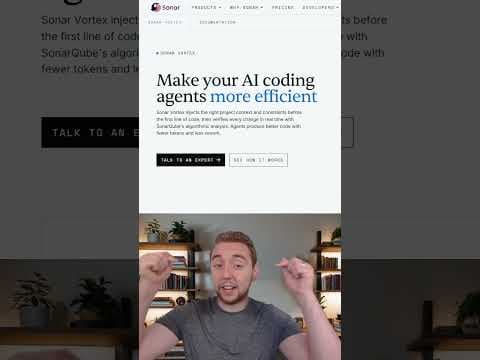
Your Coding Agent Wastes SO MANY Tokens Just Finding Code - Here's the Fix
A coding agent spends most of its cost not writing code but searching and reading files to find the right code to edit, which consumes large amounts of context and can miss correctly-needed code that is named differently. Sonar Vortex answers the single question of what code applies for a requested change directly instead of via search, using a graph built on the user's machine (no compiler or language server) that refreshes in about a millisecond after edits. It performs lookups such as which classes implement an interface and what calls a function down to file and line. In Sonar's study of six refactoring tasks across 10 runs, token savings ranged between 6% and 34%. Semantic navigation currently covers Java, C#, JavaScript, TypeScript, Python, and Rust, and it runs on SonarQube Cloud with the Sonar Agent Essentials add-on.