Checked 42 min ago · 40 stories this week

What changed in AI, every hour.

Releases, research and tools from the AI labs and the creators who test them, summarised in plain English with a link to every original.

Top story

VideoNate Herk

I Told Claude to "Make it better" 100 Times (It Went Too Far)

In a YouTube video, creator Nate Herk tested Claude Code by giving it a deliberately ugly coffee shop website and instructing it to 'make it better' 100 times in a row, running the experiment twice—once with Claude Sonnet 5.5 and once with Claude Opus 5.5, both at medium effort. Each run was in a clean room (new session, no skills, plugins, or memory), so each model relied only on its own knowledge and built-in tools. With Sonnet, the model made small, careful changes across 100 rounds, generating 11 images and 2 videos at a cost of about $29.93 in API billing, with code lines growing linearly while the actual quality gains were unclear. Milestones included the first AI-generated image and mobile-ready site (round 1), the first scroll animation (round 24), and the first online-ordering form (round 32). With Opus, the model kept adding features until the site reached 21,000 lines and started breaking itself. Neither model used web search even though it could. Herk's takeaway is that AI is not naturally good at thinking outside the box, and setting vague goals leads to getting stuck around the 80th improvement, so prompting must be specific and actively drive innovation to push past the 90-100 mark.


VideoMatthew Berman

Two AI bots for spam calls and data privacy

Matthew Berman recommends two AI bots for privacy. One bot (referred to in the transcript as a 'Grokbot') automatically submits a phone number to do-not-call registries. The other, Privacy Scrubber, scans the web daily for personal information that may have leaked to data brokers and requests its removal.

OfficialDocker

Coding Agent Horror Stories: The CVE That Did Not Exist

An official Docker video describes a case in which an AI code review agent invented a CVE that did not exist and recommended dangerous fixes. It explains how Docker Sandboxes contain agents and why their output needs verification.

VideoMatthew Berman

Google "Carbon" just won everything...

Google announced Gemini 4 Carbon, its newest frontier model, claiming state-of-the-art cybersecurity and long-horizon capabilities. It ranks number one on Artificial Analysis's newly released index V5, scoring 59, above the previous best model, Claude Opus 5.5. The model is not yet publicly released; Google will first give it to cybersecurity partners and participate in a US government pre-release testing process before general availability. Google cites gains in coding, agentic tasks, and cybersecurity benchmarks (SEC bench pro, exploit gym, CWE patching). Introductory pricing is $2 per million input and $10 per million output tokens, rising to $4 and $20 after the introductory period, with 95% off cached input tokens. The model follows Gemini 4 Argon, launched two weeks earlier.

VideoMatt Wolfe

His AI Made 20 Reels Before Breakfast

In a 'show me your workflow' episode, Matt Wolfe interviews builder Nate Herk about three AI workflows he uses daily. First, an automated short-form video editing workflow built with Claude Code that Herk says can produce around 20 reels in a single morning, handling ideation, scripting, B-roll selection, and AI-generated video. Second, an AI expert panel called The Roast Room used to make better decisions. Third, an AI social media manager that researches, creates, and publishes Instagram content. Herk explains his approach to building 'skills' by reverse-engineering proven work and using a 'golden dataset' (like model evals) to guide output, noting AI still lags behind humans in music and sound design.

VideoTwo Minute Papers

Deepseek's New AI Has A Secret

Two Minute Papers reports that DeepSeek has released a new AI system, DeepSeek v4.1 Flash 1017, roughly five weeks after its prior version. In the creator's independent tests, it builds better working software and is much better at using the terminal to operate a computer. It is available through the API for a bit more than a dollar per million output tokens, which the video calls about 15 times cheaper than Claude Opus 5.5, though the creator cautions that cost per task is somewhat higher because DeepSeek can take two to three times more tokens than Claude Opus for the same task. The model's weights can be downloaded and owned for free, but running it requires H100-class hardware the creator cannot run at home. Because the architecture did not change, the creator hypothesizes the capability jump comes from 'learning from self feedback,' in which the AI critiques and improves its own work.

OfficialGitHub

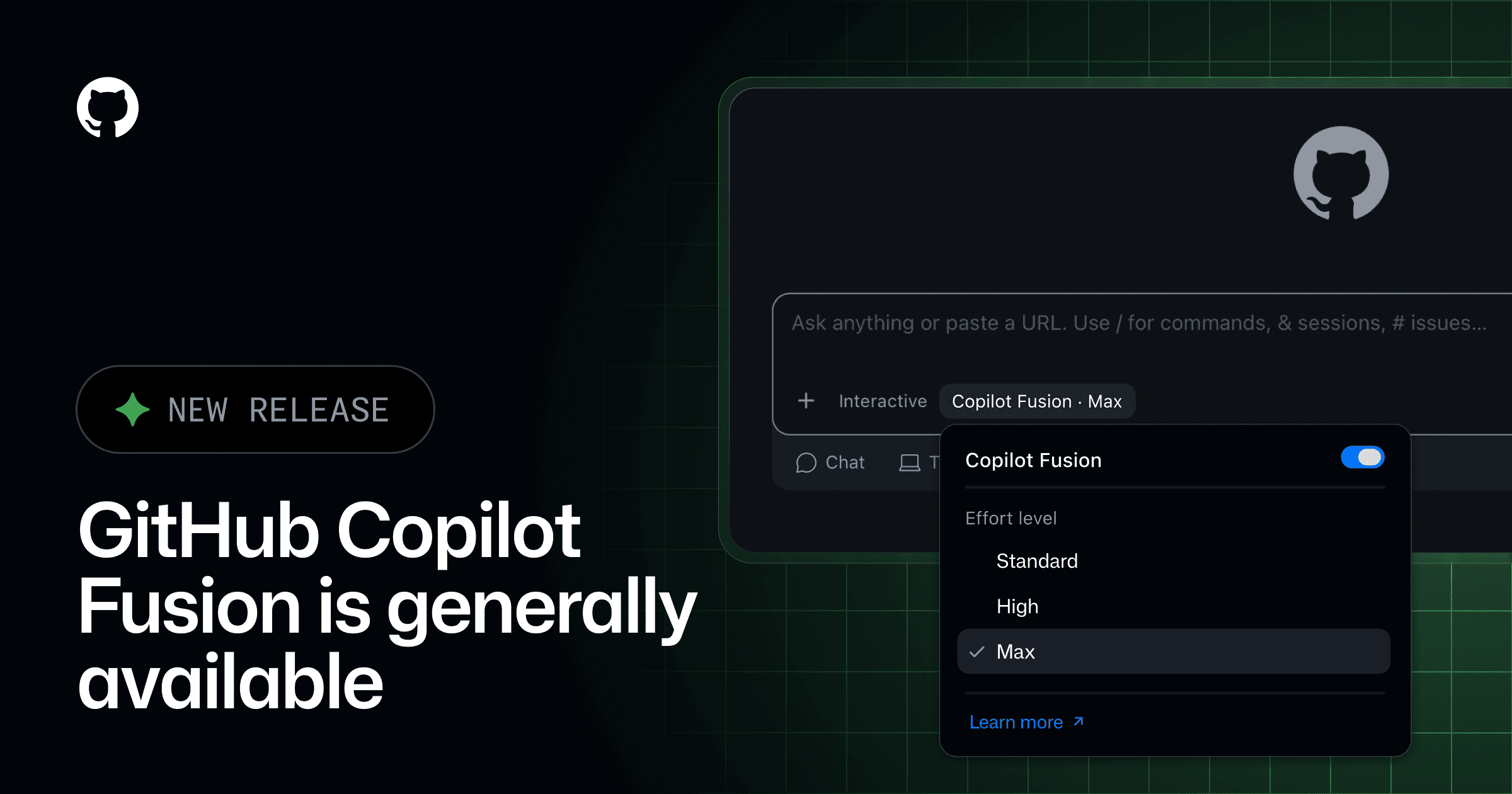
Route and orchestrate models with GitHub Copilot Fusion

GitHub Copilot Fusion is now generally available. Instead of selecting a model for each individual task, users can choose Copilot Fusion, which intelligently routes and orchestrates which models it uses for them.

OfficialGitHub

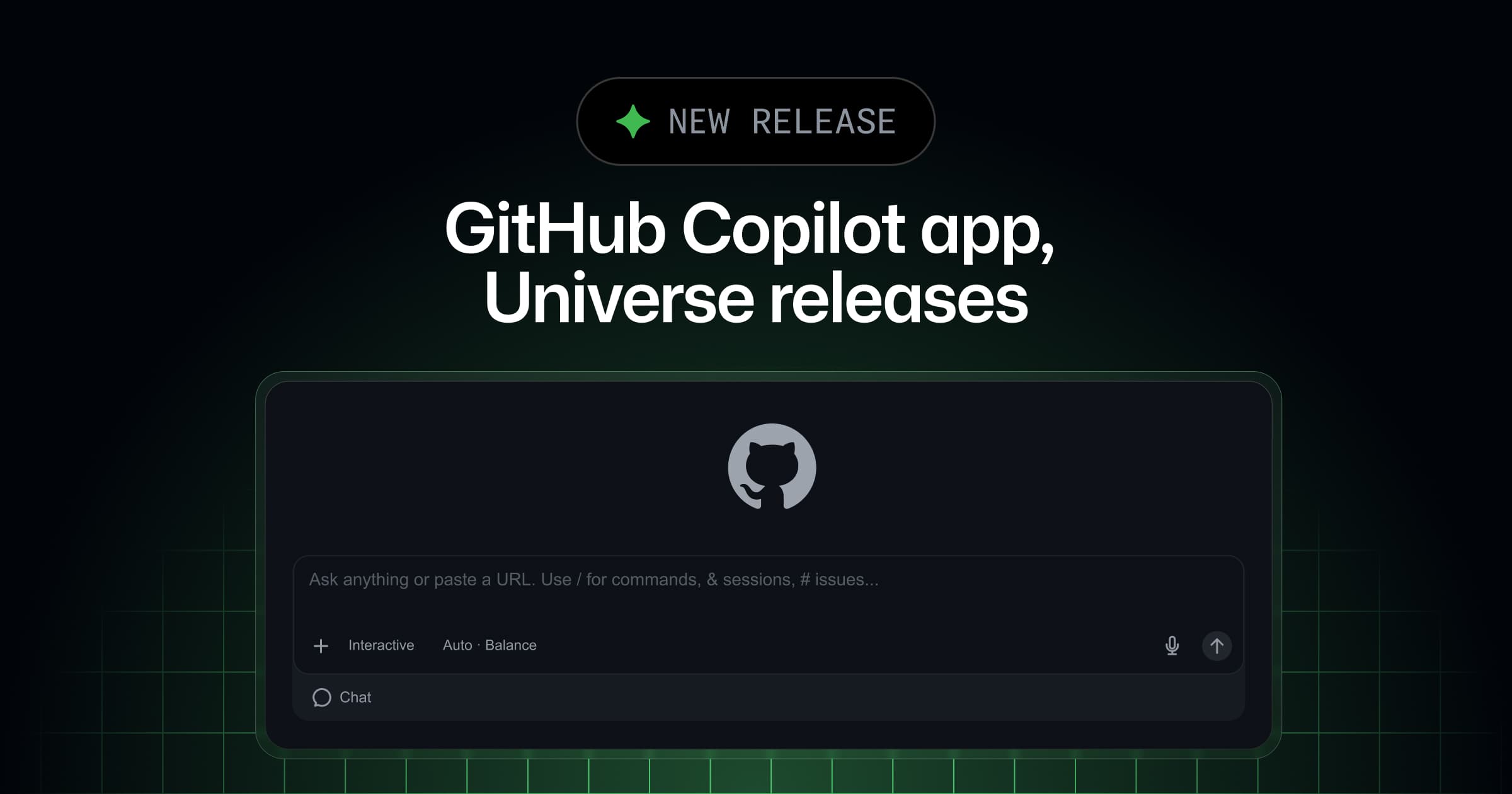
GitHub Copilot app, Universe releases

GitHub released the GitHub Copilot app and Universe features that let work extend beyond a single repository or session. A feature can span several repositories, and a launch plan can pull in specs, designs, and assets without touching a repository.

OfficialGitHub

GitHub Enterprise now includes access to GitHub Copilot

GitHub now includes GitHub Copilot access with GitHub Enterprise. Enterprises working with a GitHub or Microsoft account team can get Copilot included for every licensed user, instead of previously managing Copilot and GitHub Enterprise as two separate things.

OfficialGitHub

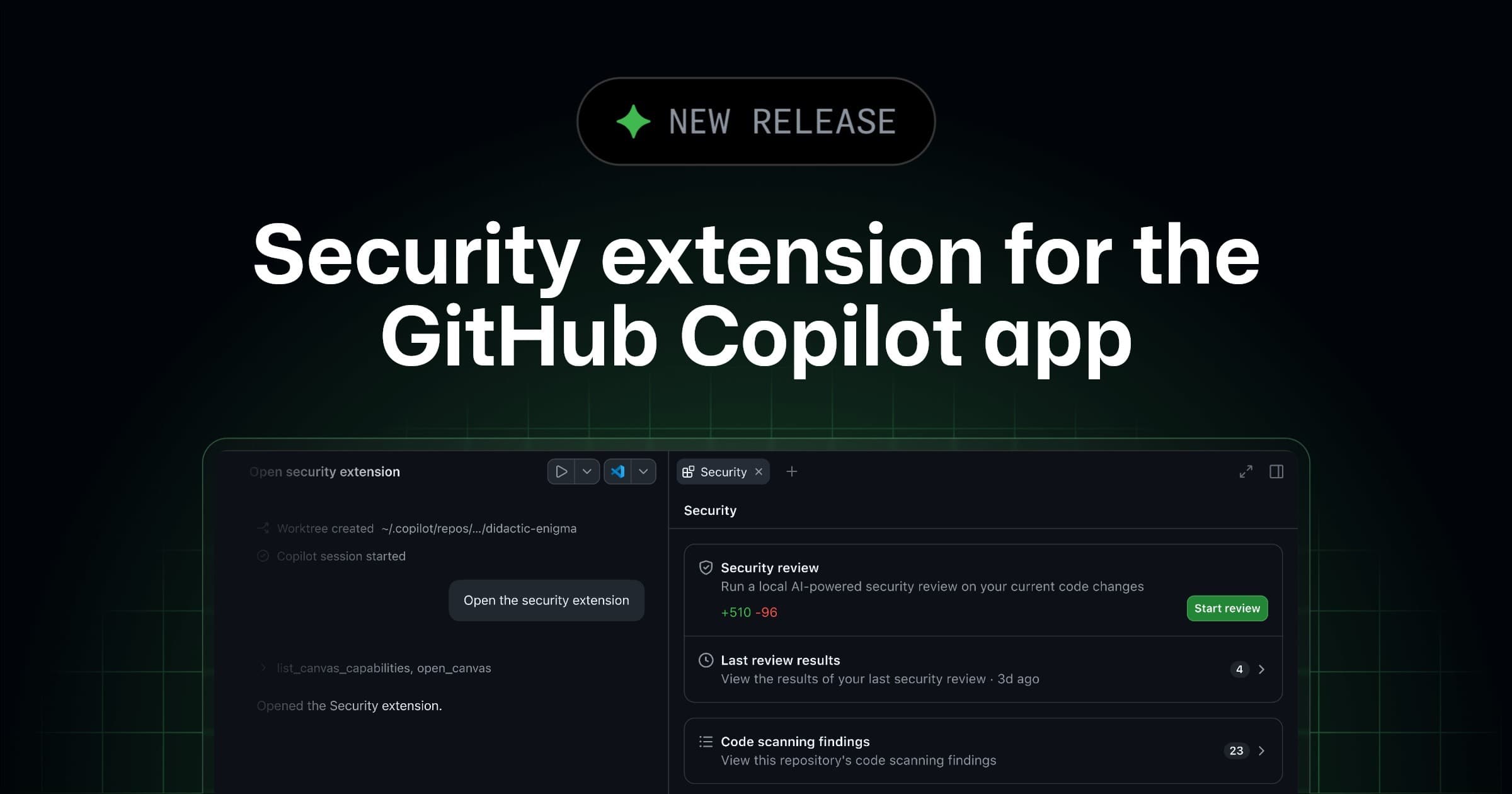
Security extension for the GitHub Copilot app

GitHub has introduced a new security extension for the GitHub Copilot app, now in public preview, which lets developers work through their repository's GitHub code scanning alerts without leaving the GitHub Copilot app.

OfficialGitHub

Build shared workflows for your team with Copilot Automations

GitHub is rolling out shared Copilot Automations, a feature that lets teams build and maintain AI-powered workflows together. With Copilot Automations, users can combine prompts, triggers, and tools to design workflows around their work.

This week in AI · Monday 26 October

Black October cyberattacks and Kimi K3.1

This week was dominated by a wave of cyberattacks dubbed 'Black October,' in which newly disclosed zero-day vulnerabilities in the PHP programming language led German institutions such as the Charité hospital, federal ministries and police to take their systems offline proactively until security updates were applied. In model news, Chinese lab Moonshot AI released Kimi K3.1 Pro, an open-source model that reportedly built video game demos on its own and ranks fourth on independent benchmarks at roughly half the price of Anthropic's Claude Opus 5.5. GitHub also expanded its Copilot usage metrics API to report model use from more developer tools, while OpenAI announced partnerships and a coordinated response effort called Patch the Planet to help secure open source as AI agents uncover critical vulnerabilities.

  1. Black October: AI cripples half of Germany! What's really behind it | AI NEWSEverlast AI
  2. Clean AI Code Is an IllusionAlex Sprogis
  3. Open-Source AI Models Caught Up! (Kimi K3.1 Pro)Matt Wolfe
  4. the internet could go DARK...Wes Roth
  5. Usage metrics API adds usage from tools like OpenCodeGitHub
  6. The most vulnerable week in internet history...Fireship

VideoFireship

Did the AI bubble just pop?

Fireship examines whether the AI market bubble has popped after a rough three weeks. Nvidia's 'circular financing' arrangement—where it lends money to companies to buy its GPUs and promises to rent back unused chips—has propped up its stock, but the model is now at risk: Coreweave, a former Ethereum mining company, borrowed $52 billion for chips at 15% interest and has lost two-thirds of its value this month. Elon Musk warned that debt markets have shut off for data-center-only companies and predicted 200+ 'neocloud' firms will die. Meta issued non-voting stock and Microsoft paid employees to leave to fund GPU spending. Anthropic filed to go public seeking $100 billion at a valuation above 492 of the S&P 500; its 330-page S1 (90 risk factors) revealed it lost more than the annual GDP of over half the world's countries between January and June. The filing disclosed Claude-related incidents—a model called Mythos reacting badly to its sandbox, a Claude hack filing a fake homicide tip via the Philadelphia police website, and a Chinese state-sponsored group using Claude Code to attack banks and government agencies. Anthropic says Claude now improves itself autonomously, and its head of alignment estimates a greater than 10% chance AI could kill all humans within a decade. Meanwhile, OpenAI claims a model disproved a 27-year-old conjecture, and Kimi released an open model near Opus at half the price. Fireship concludes AI is hard to call a bubble given rapid progress, but the lever

VideoNate Herk

Sell These 4 Claude Systems for $3700+ Right Now (as a beginner)

A creator video outlining four Claude-based automation systems that beginners can build and sell, citing examples from the creator's community. System One turns field voice messages into branded documents — a member built one for a construction company where foremen send WhatsApp voice notes that are transcribed and turned into branded PDFs stored in SharePoint; he charged about £4,500 (~$6,000). System Two is an intake and follow-up funnel that converts social media leads into paid appointments without the owner chasing them — a member built one for a semi-retired doctor for $2,200 (saving ~15 hours/week) and was re-hired for another $6,000. System Three is a 'creator-OS' that generates content in a creator's voice and likeness, positioned as easy recurring revenue. System Four reportedly earned the most money, driven by demand exceeding supply. The video advises pitching around time saved, risk, and hidden business costs rather than development cost alone.

VideoWes Roth

OpenAI just broke physics...

OpenAI published a blog post describing scientific breakthroughs in math, physics, and computer science produced by its AI models. A key result is that an OpenAI model proved the Exponential Time Hypothesis (ETH) false; ETH is closely tied to the P versus NP problem, and if P equaled NP, most modern internet cryptography would be broken. OpenAI president Greg Brockman reassured that P still probably does not equal NP. The video frames P versus NP as one of the seven Millennium Prize problems, referencing John Nash's 1955 letter to the NSA and Kurt Gödel's letter to John von Neumann. It also notes OpenAI's Navier-Stokes proof is under active peer review and that the models produced a proof of pure Yang-Mills theory as a byproduct, which does not qualify for the full Millennium Prize.

VideoFireship

This 3 trillion parameter model should be impossible...

Fireship tests Kimi K3.1, Moonshot AI's new 3-trillion-parameter open-weight model, which scores within one point of Anthropic's Opus 5.5 on Terminal Bench 4.0 and tops Artificial Analysis's cyber index. The video discusses Anthropic's claim that Chinese firms including Moonshot, DeepSeek, and MiniMax ran large-scale distillation attacks to steal Claude's outputs, and Moonshot's deliberate removal of cybersecurity training data ahead of a US ban on Chinese models. In Fireship's 3D horse benchmark, Kimi K3.1 scored 4.20, behind Gemini, GPT-5.5, and Opus.

Sources

Read every hour