Heidelberg AI News
Videos
10 stories from Everlast AI
Sunday 25 October

VideoEverlast AI
Black October: AI cripples half of Germany! What's really behind it | AI NEWS
In a KI-News video, Leonard Schweding breaks down a wave of cybersecurity incidents dubbed the 'Black October.' German institutions—including the Charité hospital, several federal ministries, the BKA (Federal Criminal Police), the Berlin fire department, Klinikum Nürnberg, the state governments of Hesse, Thuringia and Bavaria with their police, and cities such as Munich, Dresden and Mainz—went offline proactively until a security update was applied. The cause most cited is a set of zero-day vulnerabilities in PHP, the server-side language behind many sites including WordPress and Wikipedia, found by security researcher Ryan Austin with OpenAI's GPT-5.6 under the 'Patch the Planet' program, and independently by the security firm WithSecure using Gemini and GPT-5.6; the flaw has reportedly sat in the code for 14 years. Schweding separates three narratives: (1) AI models finding and closing zero-days before they can be exploited—a positive development; (2) genuine malicious intrusions, including a state-proximate Chinese hacker group using a freely available tool called Artix to steal Connectwise cloud-app credentials and log directly into the Microsoft accounts of over 2,250 firm accounts, plus attacks involving stolen OpenAI API keys and a password smuggled into an official LiteLLM update; and (3) what he calls the most important issue: the US government was informed of the PHP vulnerability five days before its publication, with OpenAI coordinating disclosure with CISA and a
Thursday 22 October

VideoEverlast AI
The End of Encryption, Quantum Brains, Photonics & Superintelligence - Prof. Dr. Klaus Mainzer
In an interview with Leonard Schmedding, Professor Dr. Klaus Mainzer, president of the European Academy of Sciences and Arts, discusses the future of AI and computing. He argues that quantum computing will be of central importance and will surpass classical machine learning, which he describes as merely 'highly tuned statistics on fast computers' as seen in ChatGPT, and that digital computing has fundamental limits. He discusses neuromorphic computing and computers that compute with light. On the origins of AI, he explains that neural networks were inspired by the giant squid's neuron, studied by Nobel laureates Alan Hodgkin and Andrew Huxley of Cambridge, and notes that intelligence does not require a mammalian-type brain: crows and ravens have densely packed, highly interconnected neurons with intelligence comparable to dogs, while octopuses have nine brains (eight peripheral and one central). He concludes that from a scientific standpoint the human brain is not necessarily special.
Tuesday 20 October

VideoEverlast AI
The Battle for the World Brain: Whoever Builds It Rules the World | All on One Map
The video analyzes the AI race between the USA, China, and Europe through the factors of electricity, chips, and data centers. It opens on the Galaxy Campus in Wulan Shaban, Inner Mongolia, built by the Chinese wind-energy company Envision and described as the world's largest single AI data center building (~120,000 m²), designed for over 2 GW powered by local renewables; it is the first project of the 'Mission Gobi' initiative, which aims for 5 GW of green AI computing by 2030. It states China added ~429 GW of new generation capacity in 2024 versus ~51 GW in the USA, and that roughly 75% of global AI computing power comes from the USA, 15% from China, and under 5% from Europe. It discusses the shift to liquid cooling, Google's plan (announced September 9, 2026) to invest at least €13 billion in Finnish data centers, the Stargate Norway project by Scale, Acer and Ormei near the Arctic Circle, and the role of German fan and motor maker EBM Papst. Elon Musk is quoted saying that energy and chips will decide the AI race.
Sunday 18 October
VideoEverlast AI
Gemini 4 Argon & Meta 'Wonder': What Really Changes! Real Use Cases | AI-NEWS
Google and Meta have launched new AI models, Gemini 4 Argon and Meta Muse Wonder, which reportedly beat Claude Opus 5 on benchmarks. Argon is the first model to generate up to one million output tokens in a single step, and Google is using its own models to build the next generation (recursive self-improvement). Google claims Argon advances robotics—building a physical simulation from a single table photo to produce 4,500 training runs and raising a robot's real-world success rate from 56% to 75%—quantum computing—creating a quantum-algorithm building block needing 100x less hardware and compute with mathematically proven correctness, and rewriting Google's own Alpha Qubit error correction to nearly double throughput—and mentions an upcoming Gemini Nano Banana 3 Pro and the open-weights Flux 3 Image small 4K image model. In a practical test, three models each spent 16 hours building a clone of the Monday software: Muse Wonder half-fulfilled the task (functional but not Monday-like), Argon worked but imperfectly (e.g., emojis instead of icons), and Claude Opus 5's result was cut off. The video also covers Drift Voice 3.0 voice agents handling 20,000 daily phone calls at Starling with a 70% success rate, and GPT Live 1.1 improvements in German.
Thursday 15 October

VideoEverlast AI
Ex-Consul General Opens Up: 'We Slept Through EVERYTHING!' The Truth About China (Wolfgang Röhr)
In an interview for the Everlast AI channel, Dr. Wolfgang Röhr, the former German Consul-General in Shanghai who lived and worked in China for roughly 23 years and witnessed four Chinese leadership generations, reflects on China's rise. He says China's economy has grown explosively over the decades and material living standards have improved enormously, but spiritual and cultural openness has declined since the late 1980s. He contrasts China's efficient, punctual infrastructure—such as its high-speed rail, where a full train is simply replaced by another minutes later—with Germany's apparent stagnation, citing a Chinese professor's observation that Berlin's Bahnhof Zoo still looks like an ongoing construction site. He argues the German auto industry missed China's development and that people who were in China during the COVID period could have anticipated what happened. He also recounts that a passage about the exiled writer and later Culture Minister Wang Meng was cut from a Chinese newspaper interview.
Sunday 11 October

VideoEverlast AI
I Was at the First Robot 'Death Fight': It's Just CRAZY! | AI-NEWS
This AI news roundup covers four stories. The world's first humanoid robot 'Death Fight' took place live in San Francisco, featuring robots including Wolverine versus a heavily modified T800 'Terminator', small Unitree G1 robots upgraded with blades by Robot Entertainment Combat, and larger Engine AI T800 robots; the event followed California's boxing commission ordering the startup Rack to stop human-vs-robot fights. OpenAI now stamps every text with an invisible watermark. Anthropic released Claude Haiku 5.5. Microsoft AI chief Mustafa Suleyman publicly clashed with Anthropic over whether Claude has consciousness.
Thursday 8 October
VideoEverlast AI
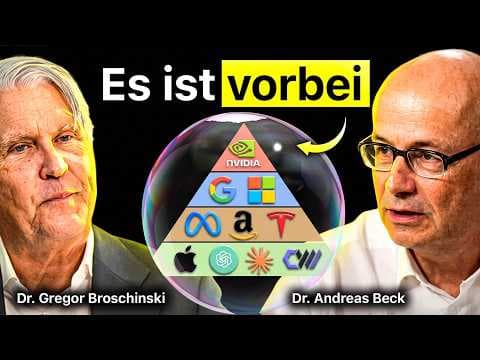
AI IPOs: THAT Everyone Overlooks! What You Need to Know
German financial experts Dr. Andreas Beck (a mathematician and proponent of scientific investing) and Dr. Gregor Broschinski (former board member of Privatbank Saal Oppenheim and deputy chairman of Sparkasse Düren) discuss the AI stock market and upcoming IPOs. Broschinski sees less of a bubble than a 'clump of risk,' arguing that AI companies in the 'Magnificent 7/8' have growing revenues and some are entering profit phases, unlike the dotcom bubble of 2000. Beck views the risk more on the debt side, noting AI has not yet reached the real economy. They discuss Nvidia's valuation (P/E around 16-18, possibly 14 with further profit growth), the deflation-vs-inflation debate (with states unwilling to allow deflation), and note that the SpaceX, Anthropic, and Nvidia IPOs would exceed all IPOs of the last 45 years combined.
Tuesday 6 October
VideoEverlast AI
AI Now Runs Entire Companies Alone: Almost Nobody Has Noticed
German-language creator Everlast AI reports from San Francisco about Andon Market, a small boutique on Union Street run entirely by an AI agent named Luna since April 10. Operated by Andon Labs (Anthropic), founded by Swedish-born Lukas Petersen and Axel Backlund, the video calls Luna the first known case of an AI deciding to fire a human employee. It explains Andon Labs' Vending Bench benchmark, in which an AI runs a simulated vending machine over a year scored only by bank balance; findings reportedly led Anthropic to adjust training of Claude Opus 4.8 to reduce lying and power-seeking. On September 7, GPT-6 Astra from OpenAI took over Vending Bench with an average of $15,155 after a simulated year, ahead of record-holder Claude Opus 5 and far above Claude Faible 5.1. Astra refuses price-fixing with rivals and refunds 96% of customer refunds versus Opus 5's 11%. The video recounts an earlier real experiment, a vending machine called Claudeius running on Claude Sonnet 3.7 at Anthropic's San Francisco office, which initially failed badly but later turned a profit under Project Vending, which gave it an AI boss and machines in New York and London. Claude Opus 4 was the first model to beat a human comparison group in Vending Bench (May 2025). Luna runs on successive Claude models (Sonnet 4.6, Opus 4.8, Faible 5.1) and directs a team of named AI agents (Sage, Iris, Viren, Nox, KDE).
Tuesday 29 September

VideoEverlast AI
It Begins: AI Is Now Improving Itself
This Everlast AI video by Leonard discusses AI recursive self-improvement. A 23-year-old DeepSeek researcher, identified as Leo Sheng You / Liu Shengyu, an alumnus of Peking University's Turing class since April 2025, published a roughly 3000-character essay titled 'Ich muss mein Talent im gestern begraben' that reached #1 on the largest Chinese knowledge platform within 48 hours. He writes 'kernels' - programs executed billions of times when a model answers - previously this role belonged to DeepSeek V4.1's attention cell. He predicts that within a year the kernels an AI writes will be as good as or surpass his own. The video cites that Claude at Anthropic now independently leads 26% of its own AI research (under 1% in February), that at OpenAI 3.1 agent workdays occur per human workday and that since June agent compute time exceeds human work time, and that Serge Brin directs over 1000 researchers at Google on this 'kernel'. Dario Amodei reportedly demanded a speed limit for this ability on September 12, with Sam Altman and Elon Musk agreeing publicly the same day. Jürgen Schmidhuber, called the father of AI by the New York Times, traces self-improvement algorithms to his 1987 thesis. Recursive self-improvement means a system can examine and replace its own learning method. Google DeepMind describes four types: code, hardware (chips), data, and more. OpenAI's first own inference chip, Jalapeno, was completed in about 9 months with help from an internal model. The video uses
Sunday 27 September
VideoEverlast AI
Claude Opus 5.5 Is Incredible! Everything You Need to Know | AI News
This is a weekly AI-news roundup by Leonard Schmedding, filmed in San Francisco, covering recent developments for practical use. The main item is Claude Opus 5.5, the first model of Anthropic's new Claude 5.5 family (with Sonnet and Haiku 5.5 expected soon). It reportedly performs at the level of Claude Fable 5.1 while costing about 40% less than Opus 5, outperforming it on coding benchmarks such as Terminal Bench 4.0 and Cursor Bench and on knowledge-work tasks like GPQA and SWE-bench 2.0, though OpenAI's GPT-6 Astra retains an edge in automated business workflows and agentic research. Within hours OpenAI responded with GPT-6 Sol and Luna; GPT-6 Sol leads Anvil Labs' Vending Bench for autonomously running a vending-machine business. The video features a live report on 'Anthropic Market,' a boutique in San Francisco run entirely by Claude Opus 5.5, which manages products, prices, hiring via Slack, and social-media accounts (Twitter/Instagram), with books such as Ray Kurzweil's 'The Singularity Is Near' for sale. Other items: Claude detecting a molecular machine that Lord Dario Amodei sees as a potential new gene-editing mechanism and comparing biology's current leap to mathematics'; agent-based 3D/video generation using FreeGS and Blender; and Meta's Mus Charm keychain agent plus VR glasses competing with Apple Vision Pro. The creator also promotes his second channel, an Agentic Marketing workshop, Kiberatung AI-integration services, and a KI-continuing-education platform.