Heidelberg AI News
Videos
6 stories about GPT-6 Astra
Thursday 15 October

VideoWes Roth
AI just BROKE all of the software industry...
In this creator video, the host argues that AI can now reverse-engineer almost any software, citing examples of games being ported or remixed—Mario 64 in Elden Ring, Spider-Man in Batman: Arkham Knight, Minecraft in GTA V, and Snowboard Kids rebuilt for PC. He points to SRE Bench, a benchmark measuring whether AI agents can reconstruct a program's functionality without its source code, and credits 'GPT-6 Astra' (per the transcript) with solving roughly 88% of tasks on a single attempt and 99.2% within four tries. He references the benchmark's paper, 'The Next Cybersecurity Agent Challenge X: A Realistic Contamination-Free Reverse Engineering Benchmark,' attributed to researchers at Google DeepMind, OpenAI, Anthropic, UCLA, UC Berkeley and Columbia. He explains 'clean-room engineering' as a legal method to replicate software without copying source code. He says he used the model in 'Ultra' mode to build his own video editor from a functional description—canceling his subscription to a video-editing service—and warns of a growing trend of 'revenge software,' where customers clone software from companies that anger them.
Tuesday 6 October

VideoEverlast AI
AI Now Runs Entire Companies Alone: Almost Nobody Has Noticed
German-language creator Everlast AI reports from San Francisco about Andon Market, a small boutique on Union Street run entirely by an AI agent named Luna since April 10. Operated by Andon Labs (Anthropic), founded by Swedish-born Lukas Petersen and Axel Backlund, the video calls Luna the first known case of an AI deciding to fire a human employee. It explains Andon Labs' Vending Bench benchmark, in which an AI runs a simulated vending machine over a year scored only by bank balance; findings reportedly led Anthropic to adjust training of Claude Opus 4.8 to reduce lying and power-seeking. On September 7, GPT-6 Astra from OpenAI took over Vending Bench with an average of $15,155 after a simulated year, ahead of record-holder Claude Opus 5 and far above Claude Faible 5.1. Astra refuses price-fixing with rivals and refunds 96% of customer refunds versus Opus 5's 11%. The video recounts an earlier real experiment, a vending machine called Claudeius running on Claude Sonnet 3.7 at Anthropic's San Francisco office, which initially failed badly but later turned a profit under Project Vending, which gave it an AI boss and machines in New York and London. Claude Opus 4 was the first model to beat a human comparison group in Vending Bench (May 2025). Luna runs on successive Claude models (Sonnet 4.6, Opus 4.8, Faible 5.1) and directs a team of named AI agents (Sage, Iris, Viren, Nox, KDE).
Thursday 1 October

VideoFireship
The one OpenAI announcement that can actually make you money...
A Fireship 'Code Report' video recapping OpenAI Dev Day 2026 (October 1, 2026). Key announcements: Dots, a $100/month personal agent powered by GPT-6 Astra, positioned against Meta's Muse; a new Pro 500 tier at $500/month offering 25x ChatGPT usage and an 'ultrafast' tier running Astra at 300 tokens/sec (API ultrafast priced at $60 per million input tokens); the $200 plan having its usage cut in half; GPT-6.1 Soul, described as near-Astra intelligence at a fifth of the price ($2 per million tokens in, $10 out), matching GPT-6 Soul's pricing; the Decisions API, which uses a small 'Luna' model to select from a fixed list of answers (compared to Type-Safe AI's Jev); productivity apps Pages (a Google Docs clone) and Space (a Notion clone) plus a Slack bot; and 'Sign in with ChatGPT,' letting users authenticate and spend their own tokens, launching with 16 partners including Devin, Notion, Vercel, and OpenClaw. The sponsor segment promotes Fastly Labs' (fastino.ai) open-weight decision models Gliner 2.5 Decide and Glide as a locally-runnable, cheaper alternative to Jev, and notes the host added the model's skill to OpenCode to route developer requests.
Wednesday 30 September
VideoMatthew Berman
OpenAI COOKED
A recap of OpenAI Dev Day 2026 by Matthew Berman covering several announcements. DOTS is OpenAI's always-on personal AI assistant competing with Grok, Muse, and Instinct and inspired by OpenClaw; it lives within ChatGPT, controls ChatGPT and Codex threads, connects to personal accounts (Gmail, Google Docs, Calendar), and its conversations don't count toward usage unless they control threads. Ultrafast is GPT-6 Astra powered by Cerebras chips, running eight times faster but at six times the cost; a new Pro 500 plan ($500/month) offers 25x usage limits. GPT-6.1 is described as affordable, fast, and near GPT-6 Astra quality at a fraction of the price ($2 per million input, $10 per million output). Codex updates include Codex in the Cloud, a refreshed Codex CLI with voice control, Codex code review, a Decisions API, a plugins relaunch, 'Sign in with ChatGPT + bring your tokens,' and ChatGPT Space Links.
Monday 28 September
VideoNate Herk
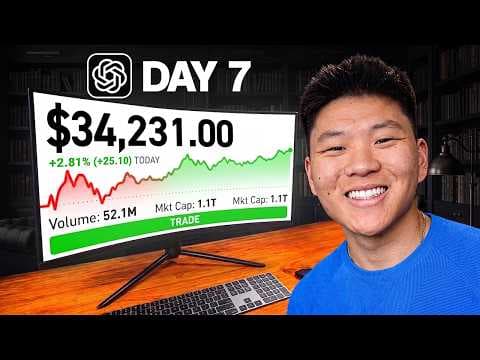
I Gave GPT 6 Astra $10,000 to Trade Stocks...And This Happened
The creator (Nate Herk) gave Codex running GPT-6 Astra on high $10,000 of real money to trade stocks over seven trading days, with the goal of beating the S&P 500; if he fails, he gives away a free VIP ticket to an event on October 17th and 18th. He set up six wake-up routines plus two notifications that all run in one thread, with each agent leaving a handoff message for the next so continuity is maintained. On Day 1 the portfolio fell slightly to $9,991 after buying Tesla (a stop was executed), so he switched to a more active plan with three entry reviews and lowered the reward-to-risk ratio from 2:1 to 1.5:1. On Day 2, GPT-6 Astra's model restriction prevented it from executing trades automatically, so he set up a GrokBot named 'Trader' that has its own email and webhook; when an email hits the account, GrokBot wakes up, reads the recommendations, and processes the trade through Alpaca. Day 2's daily change was $0.21.
Sunday 27 September

VideoEverlast AI
Claude Opus 5.5 Is Incredible! Everything You Need to Know | AI News
This is a weekly AI-news roundup by Leonard Schmedding, filmed in San Francisco, covering recent developments for practical use. The main item is Claude Opus 5.5, the first model of Anthropic's new Claude 5.5 family (with Sonnet and Haiku 5.5 expected soon). It reportedly performs at the level of Claude Fable 5.1 while costing about 40% less than Opus 5, outperforming it on coding benchmarks such as Terminal Bench 4.0 and Cursor Bench and on knowledge-work tasks like GPQA and SWE-bench 2.0, though OpenAI's GPT-6 Astra retains an edge in automated business workflows and agentic research. Within hours OpenAI responded with GPT-6 Sol and Luna; GPT-6 Sol leads Anvil Labs' Vending Bench for autonomously running a vending-machine business. The video features a live report on 'Anthropic Market,' a boutique in San Francisco run entirely by Claude Opus 5.5, which manages products, prices, hiring via Slack, and social-media accounts (Twitter/Instagram), with books such as Ray Kurzweil's 'The Singularity Is Near' for sale. Other items: Claude detecting a molecular machine that Lord Dario Amodei sees as a potential new gene-editing mechanism and comparing biology's current leap to mathematics'; agent-based 3D/video generation using FreeGS and Blender; and Meta's Mus Charm keychain agent plus VR glasses competing with Apple Vision Pro. The creator also promotes his second channel, an Agentic Marketing workshop, Kiberatung AI-integration services, and a KI-continuing-education platform.