Heidelberg AI News
Videos
3 stories about Codex
Tuesday 20 October
VideoAlex Sprogis
Developing macOS Apps with AI: Complete Guide (2026)
In this guide, content creator Alex Sprogis explains how he built a personal macOS menu bar app that monitors system performance and helps free up hard drive storage, using AI coding agents. He walks through his structured process: first drafting a product briefing that defines the target audience, platform, features, and what to exclude (since coding agents tend to overengineer), then creating a visual prototype in Claude Design (claude.ai/design) to lock in the app's look before coding, and finally having a coding agent implement the app using specifications to keep the agent organized on larger projects. He recommends native Swift development with Xcode for accessing OS system functions, and mentions using Claude Code, Cursor, and ChatGPT/Codex as coding agents.
Wednesday 30 September
VideoMatthew Berman
OpenAI COOKED
A recap of OpenAI Dev Day 2026 by Matthew Berman covering several announcements. DOTS is OpenAI's always-on personal AI assistant competing with Grok, Muse, and Instinct and inspired by OpenClaw; it lives within ChatGPT, controls ChatGPT and Codex threads, connects to personal accounts (Gmail, Google Docs, Calendar), and its conversations don't count toward usage unless they control threads. Ultrafast is GPT-6 Astra powered by Cerebras chips, running eight times faster but at six times the cost; a new Pro 500 plan ($500/month) offers 25x usage limits. GPT-6.1 is described as affordable, fast, and near GPT-6 Astra quality at a fraction of the price ($2 per million input, $10 per million output). Codex updates include Codex in the Cloud, a refreshed Codex CLI with voice control, Codex code review, a Decisions API, a plugins relaunch, 'Sign in with ChatGPT + bring your tokens,' and ChatGPT Space Links.
Monday 28 September
VideoNate Herk
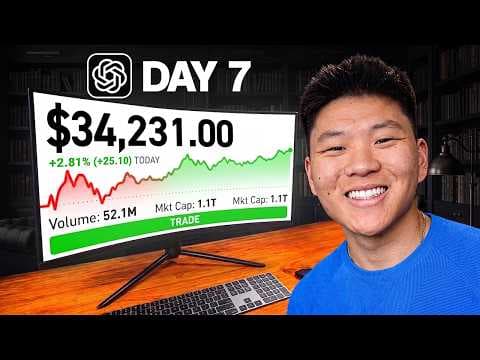
I Gave GPT 6 Astra $10,000 to Trade Stocks...And This Happened
The creator (Nate Herk) gave Codex running GPT-6 Astra on high $10,000 of real money to trade stocks over seven trading days, with the goal of beating the S&P 500; if he fails, he gives away a free VIP ticket to an event on October 17th and 18th. He set up six wake-up routines plus two notifications that all run in one thread, with each agent leaving a handoff message for the next so continuity is maintained. On Day 1 the portfolio fell slightly to $9,991 after buying Tesla (a stop was executed), so he switched to a more active plan with three entry reviews and lowered the reward-to-risk ratio from 2:1 to 1.5:1. On Day 2, GPT-6 Astra's model restriction prevented it from executing trades automatically, so he set up a GrokBot named 'Trader' that has its own email and webhook; when an email hits the account, GrokBot wakes up, reads the recommendations, and processes the trade through Alpaca. Day 2's daily change was $0.21.