Heidelberg AI News
All stories
196 stories
Friday 23 October

OfficialGitHub
GitHub Copilot in Visual Studio — September update
GitHub's official blog announced the September 2026 update to GitHub Copilot in Visual Studio. The update adds the ability to explore pull requests without leaving chat, bring the AI model your team trusts, and fix vulnerable packages the moment Visual Studio flags them.
- OpenAI
OfficialOpenAI
OpenAI and Poland's NASK partner to advance AI safety and security
OpenAI and Poland's NASK institute are partnering on AI safety, security, and technical research to strengthen safeguards and support a more resilient digital ecosystem.
OfficialGitHub
Custom skills, agents, and MCP servers in usage metrics API
GitHub's official blog announces that Copilot usage metrics now display the names of the skills, custom agents, Model Context Protocol (MCP) servers, slash commands, and plugins created by an organization, instead of grouping them under a single category.
Thursday 22 October
OfficialGitHub
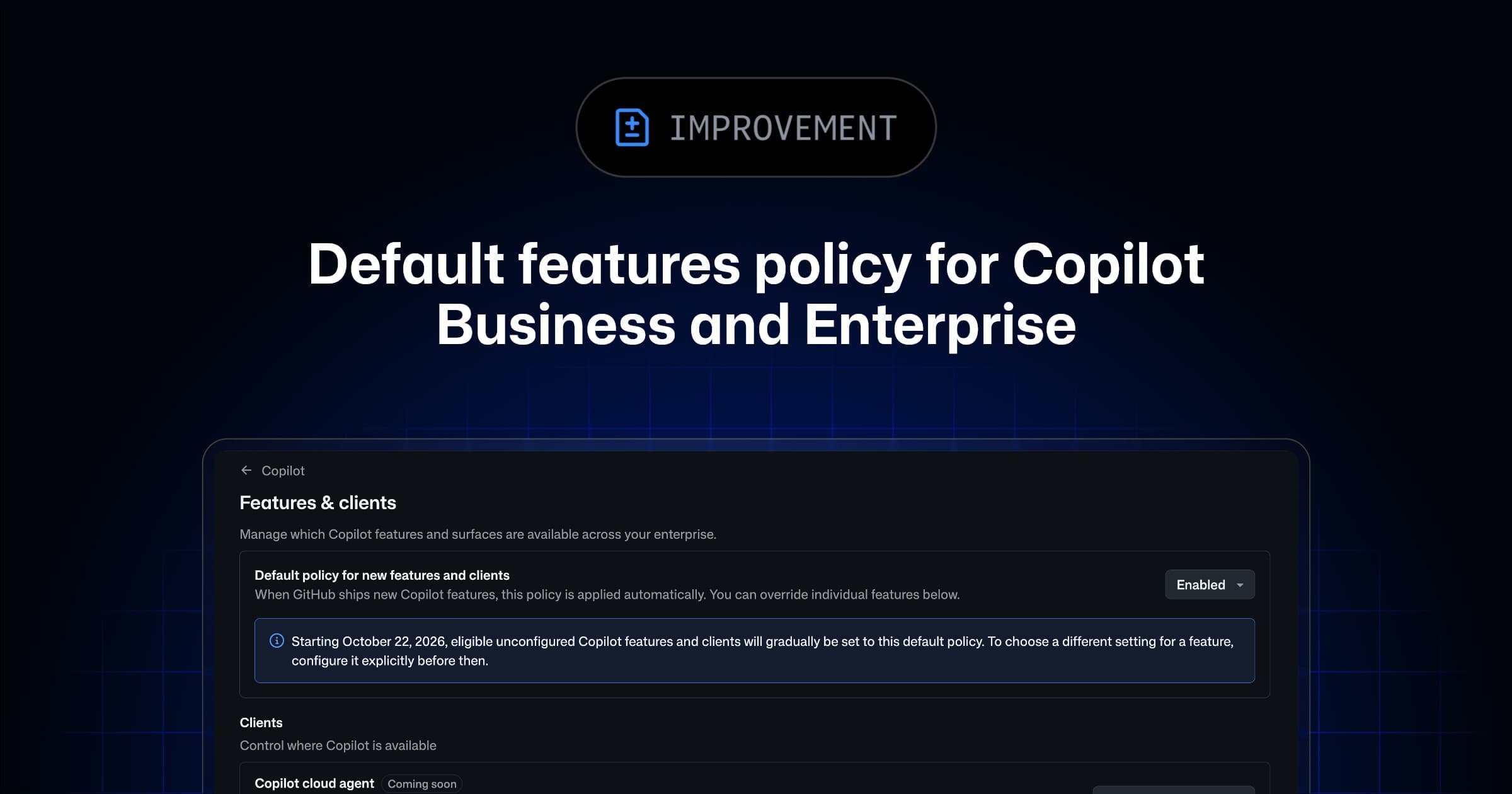
Global default for Copilot features generally available
GitHub announced a global default policy for generally available GitHub Copilot features and supported client capabilities on the Copilot Business and Copilot Enterprise plans, and is gradually rolling it out starting today.
OfficialGitHub
Meta API endpoints updated for Actions blob storage
GitHub is adding blob storage endpoints for GitHub Actions on github.com as part of ongoing work to improve capacity and reliability. The meta API now includes these new endpoints.
OfficialGitHub
Public monitoring now available with data residency
GitHub now offers public monitoring in public preview for GitHub Enterprise Cloud with data residency (GHEC DR). Public monitoring extends secret scanning beyond internal repositories.
OfficialGitHub
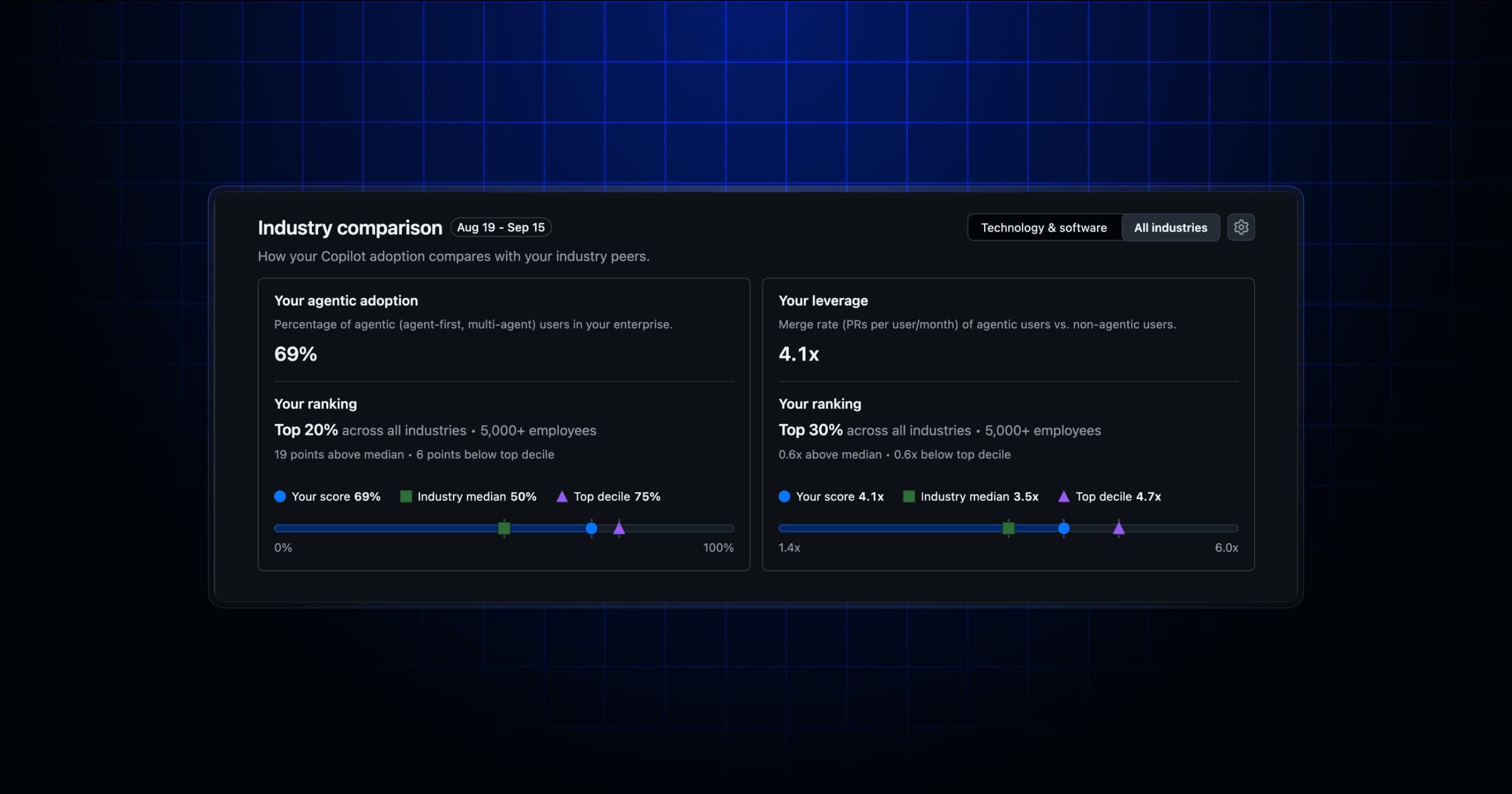
Industry comparisons in the Copilot impact dashboard
The GitHub Copilot impact dashboard now includes an 'Industry comparison' section. Enterprises and organizations not owned by an enterprise can compare their Copilot agentic adoption and leverage against aggregated benchmarks.

VideoEverlast AI
The End of Encryption, Quantum Brains, Photonics & Superintelligence - Prof. Dr. Klaus Mainzer
In an interview with Leonard Schmedding, Professor Dr. Klaus Mainzer, president of the European Academy of Sciences and Arts, discusses the future of AI and computing. He argues that quantum computing will be of central importance and will surpass classical machine learning, which he describes as merely 'highly tuned statistics on fast computers' as seen in ChatGPT, and that digital computing has fundamental limits. He discusses neuromorphic computing and computers that compute with light. On the origins of AI, he explains that neural networks were inspired by the giant squid's neuron, studied by Nobel laureates Alan Hodgkin and Andrew Huxley of Cambridge, and notes that intelligence does not require a mammalian-type brain: crows and ravens have densely packed, highly interconnected neurons with intelligence comparable to dogs, while octopuses have nine brains (eight peripheral and one central). He concludes that from a scientific standpoint the human brain is not necessarily special.

VideoNate Herk
/roast-room: How I Use Claude to Think Like the Top 1%
In this video, creator Nate Herk demonstrates his 'Roast Room,' a Claude Code repository that runs multiple sub-agents modeled on business figures such as Jeff Bezos, Alex Hormozi, Warren Buffett, Gary Vee, Dan Martell, Gino Wickman, and Paul Graham, who debate a user's business question. Each advisor is defined by a markdown agent file plus a 'brain' folder in the skills directory containing the figure's hot topics, books, frameworks, positions, policies, sources, stories, and voice, drawn from their public lectures, books, and articles. He explains the 'New Roaster' skill for creating new advisors, runs a live council debate showing opening positions, disagreements, and a final verdict, and adds Elon Musk to the council. The system outputs debate logs with opening and final votes and can export a downloadable PDF.

OfficialDocker
ActiveState Partners with Docker to Secure the Open Source in Enterprise Containers
ActiveState has partnered with Docker to help secure open source components used in enterprise containers. The collaboration addresses container security across the image, build, and runtime stages, offering practical steps to reduce the attack surface and prevent vulnerabilities from reaching production.
VideoCole Medin
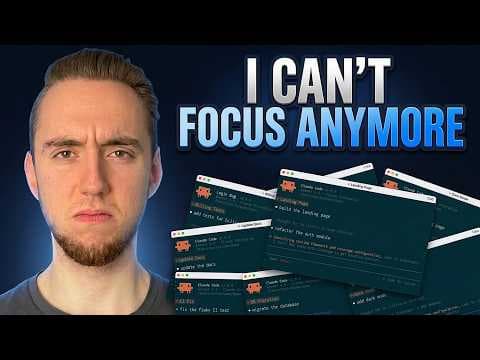
AI Makes Us WAY Faster but Fries Our Focus (Here's What I Do About It)
In this video, developer Cole Medin reflects on how AI coding has made him faster than ever, but at a cost to his focus. He says he can no longer sit down and code for four hours straight with music on; instead he runs several agent sessions at once, dictates prompts all day, and switches between tasks every few minutes, which he finds tiring. He explains that the real problem is context switching, which keeps him from getting into flow, and that every improvement to his system makes the problem worse. He concludes that he is now investing in more autonomy rather than more sessions, and believes we are living in an 'in-between' period that will end.
- OpenAI
OfficialOpenAI
Uber Brings ChatGPT Work to All Employees with OpenAI
Uber is rolling out ChatGPT Work to more than 30,000 employees, helping teams research, analyze data, create presentations, and complete complex workflows.
Wednesday 21 October

VideoMatthew Berman
Sam Altman on Why AI Needs a New Kind of Hardware
Sam Altman argues that AI is a technology that wants a new form factor. He describes laptops and iPhones as among the greatest inventions in the history of technology, but says AI is constrained by devices designed for a person rather than for AI. He finds it wasteful for a computer to spend energy rendering a user interface meant for a person to look at when AI could instead receive the data directly.

VideoMatthew Berman
Sam Altman on Why AI Hasn't Made Us Less Busy
In an interview, OpenAI CEO Sam Altman says everyone expected AI to go the other way and that there would not be enough to do, though he acknowledges that may happen someday. He notes that the outcome has been much less obvious than it seems on the surface, and that technology is supposed to enable people to work a little less and have more time for everything else. However, he observes that people seem good at wanting more out of life and the world and at making themselves busier, agreeing that this is just human nature.
VideoMatt Wolfe
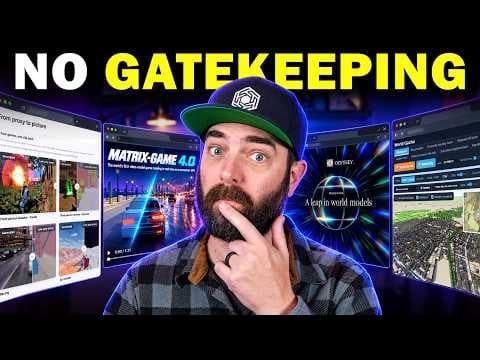
AI Breakthroughs Everyone Missed
In this AI news roundup, Matt Wolfe shares lesser-known AI developments. Fish Audio released Drama 3, a text-to-speech model that lets users direct performances in plain English using bracketed stage directions, word-specific effects, sound effects, and multiple voices; it tops Artificial Analysis on pronunciation (scoring above 11 Labs and SpaceX's model) but ranks lower on preference tests, is open-weight (36 billion parameters) on Hugging Face, needs substantial VRAM (roughly 46 GB, or about 32 GB with a community 4-bit quantization), is free for commercial use under $500,000/year revenue, and its API is $10 per million characters now, rising to $50 after November 12. BytePlus (Bite Dance) released OmniHuman 2.0, which generates talking, singing, or acting video from a single image and audio track, now up to five minutes in one continuous shot (versus 60 seconds before), in 720p, with text prompts to control camera moves, and it works on humans, cartoon characters, and animals; pricing dropped from 12 cents to 7 cents per second (about $21 for a full 5-minute video). Tencent Arc Lab released WorldCrafter, a world model that generates navigable video worlds from a single image or line of text. The video also lists additional resources including Matrix Game 4.0, NVIDIA StreamRender-H3, and an Odyssey update.
OfficialDocker
Your Agent Runs in a Docker Sandbox. Now It Can Join a Team.
Docker's official channel announces that AI agents running in Docker Sandboxes can now join a team, allowing isolated agents to collaborate across environments and manage access securely, using BAND AI.
OfficialDocker
From baseline to Secure Software Factory: securing the systems that build your software
In July, Docker, Snyk, and Keycard published Agent Baseline, an open, vendor-neutral reference architecture that defines security outcomes for running AI agents in the enterprise. The initiative grew out of conversations with industry leaders who want to adopt agents more broadly but need answers to questions about what agents are operating with what capabilities and whether they remain secure.
VideoMatthew Berman
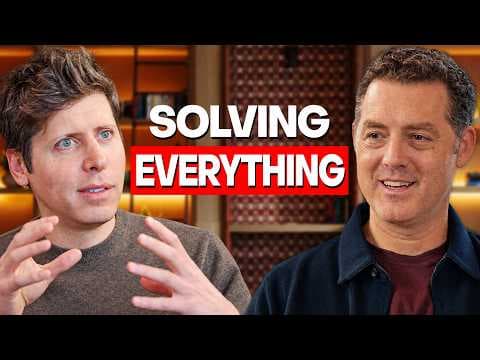
Sam Altman: RSI, AI Consciousness, OpenAI's New Hardware, Compute, and more!
In an interview with Matthew Berman, OpenAI CEO Sam Altman discusses the company's direction. He says AI is entering an era where it will help discover significant new knowledge, extending what has worked in math to biology, medicine, material science, and energy, and he hopes to have a candidate for curing or treating a major disease within the next couple of years, subject to FDA testing. He is personally excited about a potential major physics discovery. On coding, he argues coders will not lose jobs but the texture of the work changed, and the world had more demand for software than expected. He addresses AI consciousness, noting no one really knows whether current models are conscious and expressing worry about the framing and about pushing recursive self-improvement. He says ChatGPT is too agreeable. He discusses OpenAI's bet on chips and cheaper compute, describing AI as wanting a new form factor and a new kind of computer, and he reflects on the pressure of leading OpenAI, saying society should aim for a new renaissance rather than a new industrial revolution.
- OpenAI
OfficialOpenAI
OpenAI models are coming to Google Cloud
OpenAI and Google Cloud are bringing frontier OpenAI models and Codex workflows to Gemini's Model Garden, available through Google Cloud Marketplace.
- OpenAI
OfficialOpenAI
How we built ChatGPT's novel ad stack for user trust and relevance
OpenAI explains how it built ChatGPT's LLM-powered advertising stack, which is designed to understand conversational intent, keep ads separate from answers, and deliver relevant ads at scale.
- OpenAI
OfficialOpenAI
Patch the Planet: Global Response Coordination as Agents Uncover Critical Vulnerabilities
Patch the Planet is a global response coordination effort that connects security researchers, maintainers, and incident responders to help address critical vulnerabilities across open source, as AI agents increasingly uncover critical vulnerabilities.
- Google DeepMind/Google Research
OfficialGoogle DeepMind/Google Research
Southeast Asia's digital economy to hit $368 billion
Widespread AI adoption is propelling Southeast Asia's digital economy to a projected $368 billion in 2026 and $1 trillion by 2035, according to Google DeepMind/Google Research.
- OpenAI
OfficialOpenAI
Democratic governance of frontier AI, part II: Empowering cyber defenders
OpenAI has outlined a blueprint for empowering cyber defenders through frontier AI, featuring stronger safeguards, modernized cybersecurity, and more resilient public institutions, as part of its work on the democratic governance of frontier AI.
- OpenAI
OfficialOpenAI
Cloudflare links vulnerability discovery to defense with OpenAI
Cloudflare uses OpenAI's Daybreak tool to investigate vulnerabilities and propose fixes for review, and its developers use Codex to build faster and improve code quality.
Tuesday 20 October

VideoEverlast AI
The Battle for the World Brain: Whoever Builds It Rules the World | All on One Map
The video analyzes the AI race between the USA, China, and Europe through the factors of electricity, chips, and data centers. It opens on the Galaxy Campus in Wulan Shaban, Inner Mongolia, built by the Chinese wind-energy company Envision and described as the world's largest single AI data center building (~120,000 m²), designed for over 2 GW powered by local renewables; it is the first project of the 'Mission Gobi' initiative, which aims for 5 GW of green AI computing by 2030. It states China added ~429 GW of new generation capacity in 2024 versus ~51 GW in the USA, and that roughly 75% of global AI computing power comes from the USA, 15% from China, and under 5% from Europe. It discusses the shift to liquid cooling, Google's plan (announced September 9, 2026) to invest at least €13 billion in Finnish data centers, the Stargate Norway project by Scale, Acer and Ormei near the Arctic Circle, and the role of German fan and motor maker EBM Papst. Elon Musk is quoted saying that energy and chips will decide the AI race.
- OpenAI
OfficialOpenAI
Terminal X matches senior investor judgment 88.6% with GPT-6.1
OpenAI's Terminal X includes an Eval Agent that grades AI outputs against a 54-criterion rubric. Using GPT-6.1 Sol, it matches senior investor judgment 88.6% of the time and catches 25% more deviances from a fund's mandate.
VideoAlex Sprogis
Developing macOS Apps with AI: Complete Guide (2026)
In this guide, content creator Alex Sprogis explains how he built a personal macOS menu bar app that monitors system performance and helps free up hard drive storage, using AI coding agents. He walks through his structured process: first drafting a product briefing that defines the target audience, platform, features, and what to exclude (since coding agents tend to overengineer), then creating a visual prototype in Claude Design (claude.ai/design) to lock in the app's look before coding, and finally having a coding agent implement the app using specifications to keep the agent organized on larger projects. He recommends native Swift development with Xcode for accessing OS system functions, and mentions using Claude Code, Cursor, and ChatGPT/Codex as coding agents.
- OpenAI
OfficialOpenAI
OpenAI acquires Orchestra Bio
OpenAI is acquiring Orchestra Bio to bring AI-powered operations to life sciences R&D, helping biopharma teams accelerate drug development and advance new treatments.
Monday 19 October
OfficialGitHub
Copilot model policy API for enterprise, orgs, and teams
GitHub has added a REST API with GET and PATCH endpoints to retrieve and update Copilot model policies for enterprises, enterprise teams, enterprise apps, and organizations.
OfficialGitHub
GitHub Copilot models deprecated on October 19, 2026
As of October 19, 2026, GitHub deprecated certain models across most GitHub Copilot experiences, including Copilot Chat, inline edits, ask and agent modes, and code completions.