Claude Sonnet 5.5, Anthropic's newest Sonnet model, is now generally available in GitHub Copilot. It is designed for well-scoped everyday work such as building features and fixing bugs. The announcement appeared on The GitHub Blog.
Read at github.blog Summary written by an AI model from the original. Check the original before you rely on a detail.
Researchers at Epoch AI report that the open-weight Chinese model GLM 5.3 autonomously built full Firefox exploit chains with no human input, exploiting the 'patch gap' between when security fixes appear in code and when they reach users. The model identified disguised security fixes, chained vulnerabilities with a previously unpublished flaw to bypass browser sandbox protections, and could read local files when a user visited a webpage. Attacks cost about $1,000 in API fees per Firefox version across six versions released Sept 17–Oct 26, taking 12 hours for the fastest and up to 48 hours. No API providers tested triggered safety guardrails. Mozilla patched the flaw in Firefox 159.0 (Oct 27). The same setup spent roughly $100,000 on Google Chrome without producing an equivalent exploit. Researchers warn the patch-gap risk spans the software industry and note untested benchmark data suggesting Kimi K3.1 Pro could outperform GLM 5.3 on offensive cyber tasks.
AINews covers three AI developments: Mistral Large 4 ('Le Chonk') shipped as an open-weights release built for agentic coding and cybersecurity, with 1.05T total and 52B active parameters, 1M context, text+image input, and pricing near $0.70/$2.10 per 1M input/output tokens; OpenAI now monitors all frontier RL runs, evaluations, and internal Codex use using activation probes, reviewer models over reasoning and tool use, and investigator agents; and Anthropic says Claude now produces a preliminary misuse assessment immediately after each response, which it says has surfaced misuse its classifiers were not designed to catch.
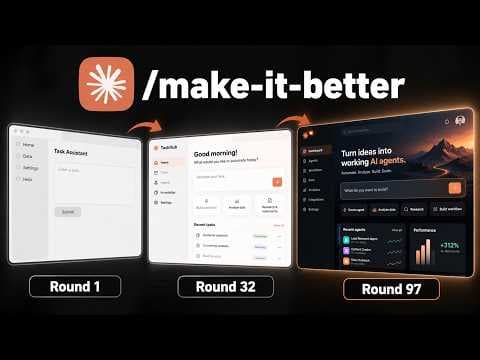
In a YouTube video, creator Nate Herk tested Claude Code by giving it a deliberately ugly coffee shop website and instructing it to 'make it better' 100 times in a row, running the experiment twice—once with Claude Sonnet 5.5 and once with Claude Opus 5.5, both at medium effort. Each run was in a clean room (new session, no skills, plugins, or memory), so each model relied only on its own knowledge and built-in tools. With Sonnet, the model made small, careful changes across 100 rounds, generating 11 images and 2 videos at a cost of about $29.93 in API billing, with code lines growing linearly while the actual quality gains were unclear. Milestones included the first AI-generated image and mobile-ready site (round 1), the first scroll animation (round 24), and the first online-ordering form (round 32). With Opus, the model kept adding features until the site reached 21,000 lines and started breaking itself. Neither model used web search even though it could. Herk's takeaway is that AI is not naturally good at thinking outside the box, and setting vague goals leads to getting stuck around the 80th improvement, so prompting must be specific and actively drive innovation to push past the 90-100 mark.
Mistral has released the weights for Mistral Large 4, nicknamed "Le Chonk," a model of about one trillion parameters (52 billion active) trained entirely in Europe and distributed under a modified MIT license that allows running it on own hardware. Independent testing by Artificial Analysis rates it 26 points on its Intelligence Index, behind open Chinese models such as DeepSeek V4.1 Flash and GLM-5.3 (32 points) and far behind the leading systems from Anthropic and Google. Mistral says it leads open models on coding, and independent benchmarks show it is fast (161 tokens per second) and cheap, but it trails Claude Opus 5.5 on coding indexes and ranks third among open models on cyber defense. Mistral cut the API price from $1.36/$4.18 to $0.70/$2.10 per million input/output tokens, and the model is available on Microsoft Foundry.