What if you could let AI make structured decisions instead of just generating text? In this tutorial, I’ll show you how to use Jev with Python to build AI-powered decision systems in just 10 minutes. We’ll start with the basics, go through the Jev cheatsheet, and send our first request.
Watch on YouTube The opening of the original, or for stories before 30 October 2026 an AI model's summary of it. Check the original before you rely on a detail.
AINews covers three AI developments: Mistral Large 4 ('Le Chonk') shipped as an open-weights release built for agentic coding and cybersecurity, with 1.05T total and 52B active parameters, 1M context, text+image input, and pricing near $0.70/$2.10 per 1M input/output tokens; OpenAI now monitors all frontier RL runs, evaluations, and internal Codex use using activation probes, reviewer models over reasoning and tool use, and investigator agents; and Anthropic says Claude now produces a preliminary misuse assessment immediately after each response, which it says has surfaced misuse its classifiers were not designed to catch.
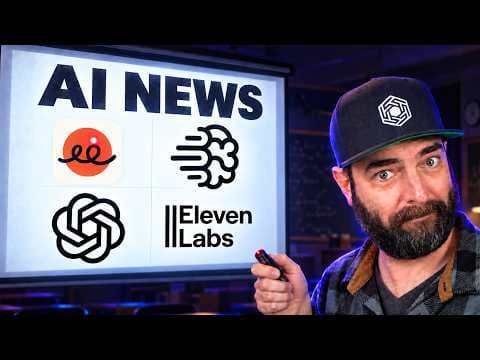
A weekly AI news roundup. Key items: Anthropic introduced Claude Duet, a proactive personal assistant agent that takes initiative, uses tools, and connects to apps such as Gmail, Slack, QuickBooks, Stripe, Gusto, LinkedIn, DocuSign, HubSpot, Canva, and Shopify; it ships with a dedicated safety classifier to guard against leaking sensitive data and is available to Pro and Max subscribers on a waitlist. It is positioned alongside ChatGPT's Dots, Meta's Muse, and xAI's Grokbot. A roughly 20-year-old PHP vulnerability was reportedly identified before attackers could exploit it by an OpenAI model; patching took some websites temporarily offline, and Cloudflare reported a massive surge in exploitation attempts after the disclosure, with a security firm calling it among the most severe vulnerabilities in software history. Railway reported a security breach in which an unauthorized party may have accessed encrypted environment variables, potentially exposing API keys that could be charged against their owners. The roundup also references OpenAI's 'Patch the Planet' initiative and briefly mentions Ideogram's new vector model and ElevenLabs' Chimera.
In this weekly AI news roundup, Matt Wolfe covers several new image models and large language models. He leads with Krea 3, a new image editing model now in public beta, calling it the best image editing experience he has had and noting it does cleaner edits than ChatGPT Image or Nano Banana for quick thumbnail changes. Three new image models are featured: Krea 3, Black Forest Labs' open-weight FLUX 3 Image Klein (which can run on consumer GPUs such as the RTX 4070 and be tried free on Hugging Face Spaces), and Alibaba's open-weight Qwen Image 2.1 Turbo. The roundup also covers Google's Gemini 4 Argon, Meta's Muse Wonder, recent OpenAI updates, and Grok Voice 3.0.
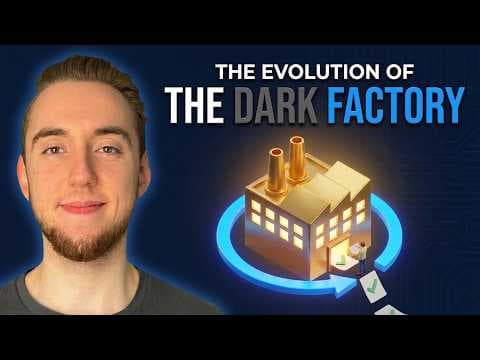
Cole Medin explains why the 'AI dark factory' - the most autonomous form of agentic engineering, where agents are handed a high-level document for an epic or release and figure out how to build, validate, and ship software straight to production - does not work, even in a hypothetical AGI world. He argues that as LLMs improve they get much better at building software but not much better at understanding human intent, so the bottleneck is always communicating what you actually want; 'LLMs can't read our minds.' He also cites maintainability concerns, noting that coding agents sprawl and cannot maintain a codebase the way humans do, referencing Dex Horthy's talk 'Why Software Factories Fail.' His inspiration was Dan Shapiro's blog post on the five levels of autonomy for AI coding, with the dark factory being level five. He has therefore shifted to an 'AI software factory' that keeps humans in the loop: he plans each release up front, runs agents in parallel through the issues, and tests everything in staging before it ships.