Massiver Durchbruch: Automatisiere ALLES mit KI-Telefonagenten in 2027! MEGA-KURS
In diesem kostenlosen Mega-Kurs lernst du, warum KI-Telefonagenten dank drei Durchbrüchen bei Intelligenz, Kosten und Anbindung jetzt flächendeckend ausgerollt werden.
Watch on YouTube The opening of the original, or for stories before 30 October 2026 an AI model's summary of it. Check the original before you rely on a detail.
Emanuel Böminghaus im Interview mit Leonard Schmedding: Der Wirtschaftsanalyst und CEO von AvenDATA über Deutschlands Niedergang, den Absturz von VW, das Ende der Callcenter, die tickende Uhr für SAP und die Chance, die Unternehmern mit KI jetzt bleibt.
In a KI-News video, Leonard Schweding breaks down a wave of cybersecurity incidents dubbed the 'Black October.' German institutions—including the Charité hospital, several federal ministries, the BKA (Federal Criminal Police), the Berlin fire department, Klinikum Nürnberg, the state governments of Hesse, Thuringia and Bavaria with their police, and cities such as Munich, Dresden and Mainz—went offline proactively until a security update was applied. The cause most cited is a set of zero-day vulnerabilities in PHP, the server-side language behind many sites including WordPress and Wikipedia, found by security researcher Ryan Austin with OpenAI's GPT-5.6 under the 'Patch the Planet' program, and independently by the security firm WithSecure using Gemini and GPT-5.6; the flaw has reportedly sat in the code for 14 years. Schweding separates three narratives: (1) AI models finding and closing zero-days before they can be exploited—a positive development; (2) genuine malicious intrusions, including a state-proximate Chinese hacker group using a freely available tool called Artix to steal Connectwise cloud-app credentials and log directly into the Microsoft accounts of over 2,250 firm accounts, plus attacks involving stolen OpenAI API keys and a password smuggled into an official LiteLLM update; and (3) what he calls the most important issue: the US government was informed of the PHP vulnerability five days before its publication, with OpenAI coordinating disclosure with CISA and a
In an interview with Leonard Schmedding, Professor Dr. Klaus Mainzer, president of the European Academy of Sciences and Arts, discusses the future of AI and computing. He argues that quantum computing will be of central importance and will surpass classical machine learning, which he describes as merely 'highly tuned statistics on fast computers' as seen in ChatGPT, and that digital computing has fundamental limits. He discusses neuromorphic computing and computers that compute with light. On the origins of AI, he explains that neural networks were inspired by the giant squid's neuron, studied by Nobel laureates Alan Hodgkin and Andrew Huxley of Cambridge, and notes that intelligence does not require a mammalian-type brain: crows and ravens have densely packed, highly interconnected neurons with intelligence comparable to dogs, while octopuses have nine brains (eight peripheral and one central). He concludes that from a scientific standpoint the human brain is not necessarily special.
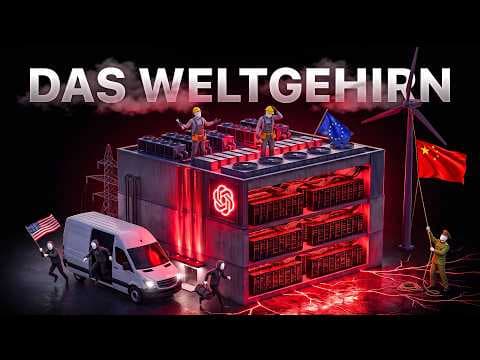
The video analyzes the AI race between the USA, China, and Europe through the factors of electricity, chips, and data centers. It opens on the Galaxy Campus in Wulan Shaban, Inner Mongolia, built by the Chinese wind-energy company Envision and described as the world's largest single AI data center building (~120,000 m²), designed for over 2 GW powered by local renewables; it is the first project of the 'Mission Gobi' initiative, which aims for 5 GW of green AI computing by 2030. It states China added ~429 GW of new generation capacity in 2024 versus ~51 GW in the USA, and that roughly 75% of global AI computing power comes from the USA, 15% from China, and under 5% from Europe. It discusses the shift to liquid cooling, Google's plan (announced September 9, 2026) to invest at least €13 billion in Finnish data centers, the Stargate Norway project by Scale, Acer and Ormei near the Arctic Circle, and the role of German fan and motor maker EBM Papst. Elon Musk is quoted saying that energy and chips will decide the AI race.