Video · Nate Herk ·

Oracle's New AI Only Thinks When It Has To
Oracle announced Fusion Cloud, an enterprise AI approach in which advanced AI models perform complex thinking, planning, and adaptation while deterministic computing handles precise, high-volume repetitive execution. It targets large workflows across finance, hiring, supply chains, logistics, and sales, with users defining agent permissions, approvals, and when humans should intervene. Oracle already has 25 AI-powered applications built on this idea and will reveal Fusion Cloud and these applications at Oracle AI World in Las Vegas on October 26-27.

Watch on YouTube Summary written by an AI model from the original. Check the original before you rely on a detail.

More from Nate Herk

All stories

VideoNate Herk

I Told Claude to "Make it better" 100 Times (It Went Too Far)

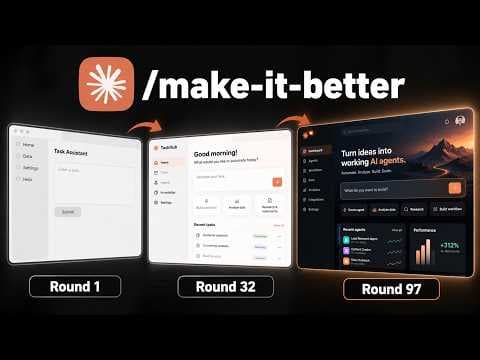
In a YouTube video, creator Nate Herk tested Claude Code by giving it a deliberately ugly coffee shop website and instructing it to 'make it better' 100 times in a row, running the experiment twice—once with Claude Sonnet 5.5 and once with Claude Opus 5.5, both at medium effort. Each run was in a clean room (new session, no skills, plugins, or memory), so each model relied only on its own knowledge and built-in tools. With Sonnet, the model made small, careful changes across 100 rounds, generating 11 images and 2 videos at a cost of about $29.93 in API billing, with code lines growing linearly while the actual quality gains were unclear. Milestones included the first AI-generated image and mobile-ready site (round 1), the first scroll animation (round 24), and the first online-ordering form (round 32). With Opus, the model kept adding features until the site reached 21,000 lines and started breaking itself. Neither model used web search even though it could. Herk's takeaway is that AI is not naturally good at thinking outside the box, and setting vague goals leads to getting stuck around the 80th improvement, so prompting must be specific and actively drive innovation to push past the 90-100 mark.

VideoNate Herk

Sell These 4 Claude Systems for $3700+ Right Now (as a beginner)

A creator video outlining four Claude-based automation systems that beginners can build and sell, citing examples from the creator's community. System One turns field voice messages into branded documents — a member built one for a construction company where foremen send WhatsApp voice notes that are transcribed and turned into branded PDFs stored in SharePoint; he charged about £4,500 (~$6,000). System Two is an intake and follow-up funnel that converts social media leads into paid appointments without the owner chasing them — a member built one for a semi-retired doctor for $2,200 (saving ~15 hours/week) and was re-hired for another $6,000. System Three is a 'creator-OS' that generates content in a creator's voice and likeness, positioned as easy recurring revenue. System Four reportedly earned the most money, driven by demand exceeding supply. The video advises pitching around time saved, risk, and hidden business costs rather than development cost alone.

VideoNate Herk

/roast-room: How I Use Claude to Think Like the Top 1%

In this video, creator Nate Herk demonstrates his 'Roast Room,' a Claude Code repository that runs multiple sub-agents modeled on business figures such as Jeff Bezos, Alex Hormozi, Warren Buffett, Gary Vee, Dan Martell, Gino Wickman, and Paul Graham, who debate a user's business question. Each advisor is defined by a markdown agent file plus a 'brain' folder in the skills directory containing the figure's hot topics, books, frameworks, positions, policies, sources, stories, and voice, drawn from their public lectures, books, and articles. He explains the 'New Roaster' skill for creating new advisors, runs a live council debate showing opening positions, disagreements, and a final verdict, and adds Elon Musk to the council. The system outputs debate logs with opening and final votes and can export a downloadable PDF.

VideoNate Herk

Matt Pocock: The Most Valuable Skill to Learn in the Age of AI

In a podcast interview, developer Matt Pocock—who taught himself to code and worked as a developer for roughly 18 years—explains how he now relies on AI coding agents. He says the best results come from telling agents what you care about and improving the codebase and environment they work in, because agents fill gaps with their own assumptions. He says spec-driven development made his code worse for months. He considers the release of Claude Opus 4.5 and Open Claw in December 2025 the point where he stopped writing code himself, and he runs Claude Opus 5.5 on medium effort. He argues software-engineering fundamentals—good tests, audits, and preventing error classes—matter more now, and that non-technical people can seize opportunities by using agents to identify cognitive workflows and present them to organizations. On trust, he recommends skepticism and reading primary sources rather than trusting agent output, noting that agent hallucinations have decreased but still occur.