Article · Latent Space ·

Why Agents Love Supabase
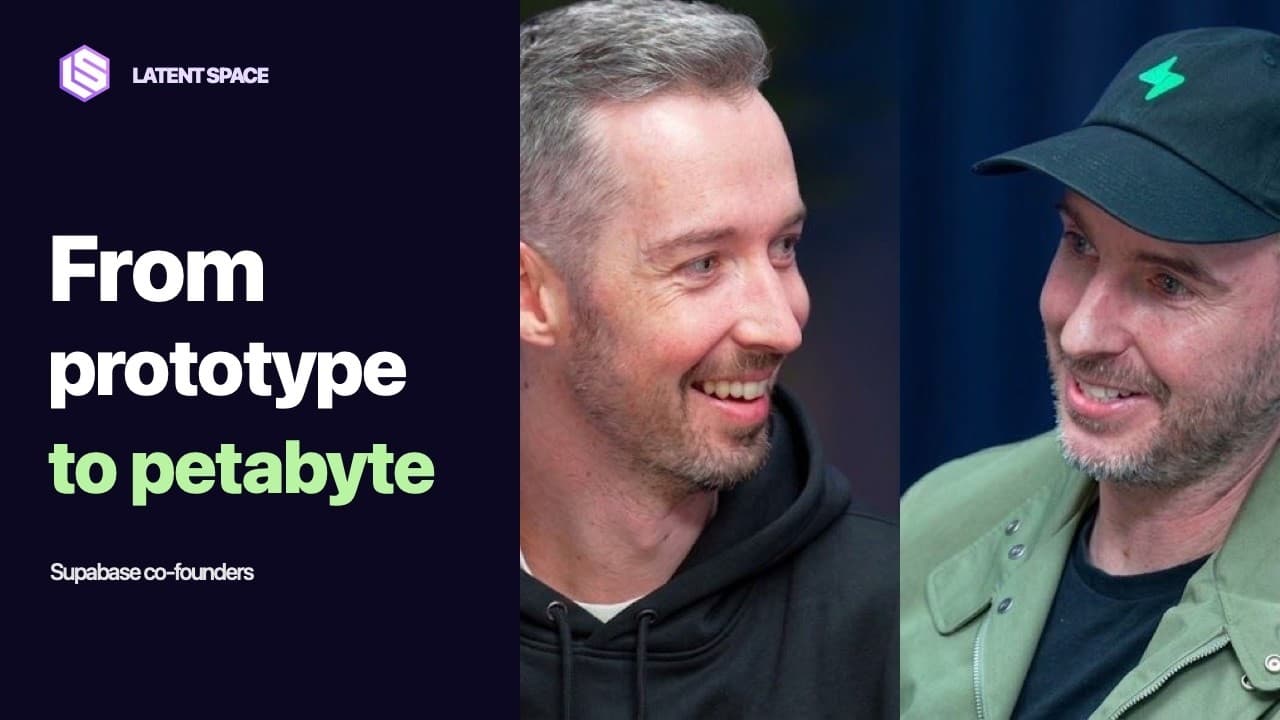
In a Latent Space podcast episode, Supabase founders Paul Copplestone and Ant Wilson discuss the company's Select announcements, grouped into Build, Operate, and Scale. Build features include a new alpha runtime for running Supabase locally without Docker, declarative database schemas kept in Git that an agent can read, change and fork, and Supabase Compute to run workloads beside the database. Operate adds logs, checks, connections and context to help an agent understand what it is changing. Scale covers OrioleDB, Multigres and the Turso acquisition behind a 'prototype to petabyte' positioning, as Supabase launches about five million databases a month. The founders say AI-driven agent usage improved activation and conversion because an agent can carry a user from signup to a working setup in one flow.
Read at latent.space Summary written by an AI model from the original. Check the original before you rely on a detail.

Tools in this story

Each tool opens in the Heidelberg AI Curriculum: what it does, what it costs, how to start.

Related stories

All stories

VideoNate Herk

I Told Claude to "Make it better" 100 Times (It Went Too Far)

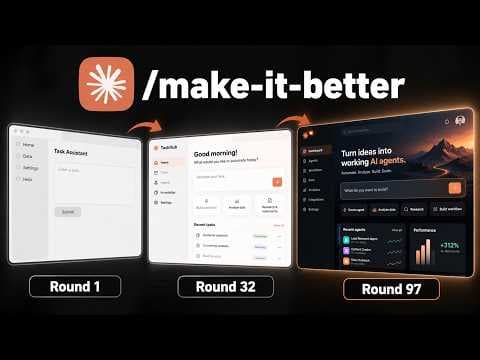
In a YouTube video, creator Nate Herk tested Claude Code by giving it a deliberately ugly coffee shop website and instructing it to 'make it better' 100 times in a row, running the experiment twice—once with Claude Sonnet 5.5 and once with Claude Opus 5.5, both at medium effort. Each run was in a clean room (new session, no skills, plugins, or memory), so each model relied only on its own knowledge and built-in tools. With Sonnet, the model made small, careful changes across 100 rounds, generating 11 images and 2 videos at a cost of about $29.93 in API billing, with code lines growing linearly while the actual quality gains were unclear. Milestones included the first AI-generated image and mobile-ready site (round 1), the first scroll animation (round 24), and the first online-ordering form (round 32). With Opus, the model kept adding features until the site reached 21,000 lines and started breaking itself. Neither model used web search even though it could. Herk's takeaway is that AI is not naturally good at thinking outside the box, and setting vague goals leads to getting stuck around the 80th improvement, so prompting must be specific and actively drive innovation to push past the 90-100 mark.

Latent Space

ArticleLatent Space

Can Frontier Models See Past a Decoy? Elorian Tests Visual Reasoning

Elorian, which emerged from stealth in April with $55 million in seed funding co-led by Striker Venture Partners, Menlo Ventures and Altimeter Capital, launched its first visual reasoning model, Glimpse, described as a 'visual thinking model' that reasons about the physical world from what it sees. In partnership with AI data company Mercor, Elorian co-released DecoyCount, a benchmark testing whether models genuinely count objects or rely on visual shortcuts and substitution heuristics. According to a paper accompanying the release, frontier models scored below 50% accuracy, with GPT-6 Astra highest at 43.17%. CEO Andrew Dai said Glimpse scored 50.48% on 1,660 DecoyCount items in an internal test, making it the only model to clear 50%, though he noted the result came from a single run versus the frontier models' three-run averages. Dai, a former Google DeepMind researcher on GLaM MoE, PaLM 2 and Gemini, said the model uses visual thinking—generating and editing images as part of the reasoning trace—and distinguished Elorian's 'indirect action' approach from world models like World Labs' Atlas and Google's Genie 4.

ArticleThe Decoder

Paris-based Mistral releases "Le Chonk," a strong coding model that still trails China overall

Mistral has released the weights for Mistral Large 4, nicknamed "Le Chonk," a model of about one trillion parameters (52 billion active) trained entirely in Europe and distributed under a modified MIT license that allows running it on own hardware. Independent testing by Artificial Analysis rates it 26 points on its Intelligence Index, behind open Chinese models such as DeepSeek V4.1 Flash and GLM-5.3 (32 points) and far behind the leading systems from Anthropic and Google. Mistral says it leads open models on coding, and independent benchmarks show it is fast (161 tokens per second) and cheap, but it trails Claude Opus 5.5 on coding indexes and ranks third among open models on cyber defense. Mistral cut the API price from $1.36/$4.18 to $0.70/$2.10 per million input/output tokens, and the model is available on Microsoft Foundry.

OfficialDocker

Coding Agent Horror Stories: The CVE That Did Not Exist

An official Docker video describes a case in which an AI code review agent invented a CVE that did not exist and recommended dangerous fixes. It explains how Docker Sandboxes contain agents and why their output needs verification.