Heidelberg AI News
Videos
15 stories from Nate Herk
Friday 30 October
VideoNate Herk
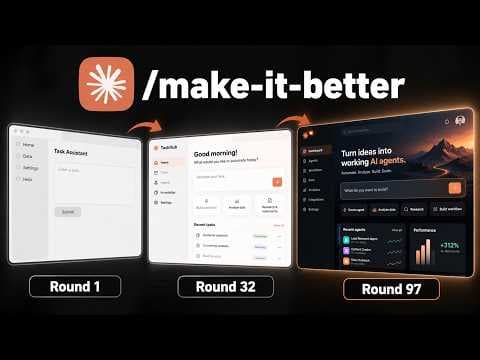
I Told Claude to "Make it better" 100 Times (It Went Too Far)
In a YouTube video, creator Nate Herk tested Claude Code by giving it a deliberately ugly coffee shop website and instructing it to 'make it better' 100 times in a row, running the experiment twice—once with Claude Sonnet 5.5 and once with Claude Opus 5.5, both at medium effort. Each run was in a clean room (new session, no skills, plugins, or memory), so each model relied only on its own knowledge and built-in tools. With Sonnet, the model made small, careful changes across 100 rounds, generating 11 images and 2 videos at a cost of about $29.93 in API billing, with code lines growing linearly while the actual quality gains were unclear. Milestones included the first AI-generated image and mobile-ready site (round 1), the first scroll animation (round 24), and the first online-ordering form (round 32). With Opus, the model kept adding features until the site reached 21,000 lines and started breaking itself. Neither model used web search even though it could. Herk's takeaway is that AI is not naturally good at thinking outside the box, and setting vague goals leads to getting stuck around the 80th improvement, so prompting must be specific and actively drive innovation to push past the 90-100 mark.
Tuesday 27 October

VideoNate Herk
Sell These 4 Claude Systems for $3700+ Right Now (as a beginner)
A creator video outlining four Claude-based automation systems that beginners can build and sell, citing examples from the creator's community. System One turns field voice messages into branded documents — a member built one for a construction company where foremen send WhatsApp voice notes that are transcribed and turned into branded PDFs stored in SharePoint; he charged about £4,500 (~$6,000). System Two is an intake and follow-up funnel that converts social media leads into paid appointments without the owner chasing them — a member built one for a semi-retired doctor for $2,200 (saving ~15 hours/week) and was re-hired for another $6,000. System Three is a 'creator-OS' that generates content in a creator's voice and likeness, positioned as easy recurring revenue. System Four reportedly earned the most money, driven by demand exceeding supply. The video advises pitching around time saved, risk, and hidden business costs rather than development cost alone.
Thursday 22 October

VideoNate Herk
/roast-room: How I Use Claude to Think Like the Top 1%
In this video, creator Nate Herk demonstrates his 'Roast Room,' a Claude Code repository that runs multiple sub-agents modeled on business figures such as Jeff Bezos, Alex Hormozi, Warren Buffett, Gary Vee, Dan Martell, Gino Wickman, and Paul Graham, who debate a user's business question. Each advisor is defined by a markdown agent file plus a 'brain' folder in the skills directory containing the figure's hot topics, books, frameworks, positions, policies, sources, stories, and voice, drawn from their public lectures, books, and articles. He explains the 'New Roaster' skill for creating new advisors, runs a live council debate showing opening positions, disagreements, and a final verdict, and adds Elon Musk to the council. The system outputs debate logs with opening and final votes and can export a downloadable PDF.
Friday 16 October

VideoNate Herk
Matt Pocock: The Most Valuable Skill to Learn in the Age of AI
In a podcast interview, developer Matt Pocock—who taught himself to code and worked as a developer for roughly 18 years—explains how he now relies on AI coding agents. He says the best results come from telling agents what you care about and improving the codebase and environment they work in, because agents fill gaps with their own assumptions. He says spec-driven development made his code worse for months. He considers the release of Claude Opus 4.5 and Open Claw in December 2025 the point where he stopped writing code himself, and he runs Claude Opus 5.5 on medium effort. He argues software-engineering fundamentals—good tests, audits, and preventing error classes—matter more now, and that non-technical people can seize opportunities by using agents to identify cognitive workflows and present them to organizations. On trust, he recommends skepticism and reading primary sources rather than trusting agent output, noting that agent hallucinations have decreased but still occur.
Wednesday 14 October

VideoNate Herk
Claude has completely changed how I edit videos
Creator Nate Herk describes editing an entire short video using Claude, which transcribes his speech, trims retakes and pauses longer than a fifth of a second, plans the narrative, sources B-roll (real clips, screen recordings, or AI-generated video), generates motion graphics and code synced to specific words, selects music by mood, adds sound effects, and self-checks lip sync, caption contrast, and audio levels.
Tuesday 13 October
VideoNate Herk
I Tested the Viral Reverse Engineer Anything Skill. What You Need to Know.
The creator tests the 'Reverse Engineer Anything' (REA) GitHub repo by Matthew Bourbon, which uses AI agents to analyze existing app features and recreate their functionality. Working with Claude Code, he built a Loom-inspired screen recorder (Herk Recorder), a version of Sand Castles, and drew inspiration from Langfuse for their AIS eval studio. He argues the technique isn't new—it's 'reverse engineering the output' by giving AI clear examples of the desired result (e.g., analyzing his own Instagram reels or a motion-edit video to build a skill). His main point: AI isn't creative but executes well when given specific examples and clear intent rather than generic goals.

VideoNate Herk
I Built the Ultimate AI Board of Advisors
In a video, creator Nate Herk describes building AI agent personas of famous business figures—Jeff Bezos, Paul Graham, Gary Vaynerchuk, Dan Martell, Gino Wickman, and Warren Buffett—as 'Claude Agents' he can talk to anytime. He set up a 'roast room' in Claude Code that activates seven sub-agents, which discuss, debate, and vote on options, then produce a PDF summarizing the council's decisions, weighted scores, recommendations, key points, and how the council reached its decisions. He gathered more than 1.3 million words of public videos and discussions about each figure to build the personas.

VideoNate Herk
I Built the Ultimate AI Board of Advisors (free claude skill)
The creator built a 'Roast Room' skill in Claude Code in which seven AI personas—modeled on Jeff Bezos, Paul Graham, Alex Hormozi, Gary Vaynerchuk, Dan Martell, Gino Wickman and Warren Buffett—debate a business decision and return a scored verdict. He explains that each persona runs as a sub-agent talking through a chairperson who moderates the debate across multiple rounds, that the council scores each option and reaches a final verdict, and that the full evaluation can be exported as a PDF. He also shows how to install the free skill and how to ask better questions so the council challenges the user's thinking and helps weigh options.
Friday 9 October

VideoNate Herk
Oracle's New AI Only Thinks When It Has To
Oracle announced Fusion Cloud, an enterprise AI approach in which advanced AI models perform complex thinking, planning, and adaptation while deterministic computing handles precise, high-volume repetitive execution. It targets large workflows across finance, hiring, supply chains, logistics, and sales, with users defining agent permissions, approvals, and when humans should intervene. Oracle already has 25 AI-powered applications built on this idea and will reveal Fusion Cloud and these applications at Oracle AI World in Las Vegas on October 26-27.

VideoNate Herk
Grok Bot Just Got 2 Massive Upgrades. Do These Things Now.
Grok Bot has two new upgrades: automatic model routing and native X search. The creator explains switching his bots away from the paid X API, why he's rethinking how he structures his skills, and what he'd still like to see from model routing. He also shares his favorite setup of running Claude Code inside Grok Bot with his own subscription to access his projects from his phone.
Thursday 8 October
VideoNate Herk
Anthropic Engineers Just 10x'd Everyone's Claude Code
Anthropic engineers report removing more than 80% of Claude Code's system prompt while preserving model evaluation scores, which they say roughly tenfolded its speed. An Anthropic engineer published an article titled 'The New Rules of Context Engineering for Claude 3.5 Generation Models,' arguing that excess context slows the model and recommending the minimum context needed for a desired result, plus loading MCP tool definitions only when needed. Anthropic says this reduced token usage by 85% and raised MCP evaluation scores. A 2025 study of five models found performance fell 13.9% to 85% as input grew. The creator applied the guidance by auditing his own setup with Claude Code's /doctor command and trimming his CLAUDE.md and skills.
Monday 5 October

VideoNate Herk
I Built Another Andrej Karpathy Using Claude
In a creator video, Nate Herk explains how he built a Claude Code agent that condenses the teaching style of Andrej Karpathy, an AI expert who was a founding member of OpenAI in 2015, ran AI at Tesla for about five years leading the computer vision team behind autopilot, started Eureka Labs, and as of May is on Anthropic's pre-training team. Herk stresses the agent is not a voice clone but is built from over 700,000 words of Karpathy's blogs, lecture transcripts, GitHub repos, and X posts, and follows seven rules from his writing, such as building the smallest version first, predicting outcomes before running, showing the broken version, and never handing over code he hasn't run himself. He says the goal is to fix AI's habit of 'sounding right instead of being right' and to bring expert quality into what you build with AI, noting Karpathy publicly reported in August last year that getting Claude Code to teach him alongside code 'didn't work at all.' Herk walks through the build: crawling sources with the Python packages YouTube Transcript API and yt-dlp for YouTube and the paid twitterapi.io for X (about a dollar for every post since 2023), running one agent per source in parallel for about 45 minutes to an hour, then compiling the raw files into a wiki using Karpathy's own LLM wiki memory system idea from April, stored in a gist, producing a wiki viewable in Obsidian.
Tuesday 29 September
VideoNate Herk
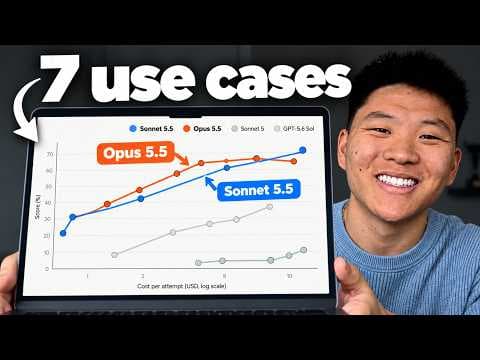
I Tested Sonnet 5.5 vs Opus 5.5. What You Need to Know.
In a video by Nate Herk, Claude Sonnet 5.5 is tested against Opus 5.5 across seven real workflows (landing pages, messy data turned into spreadsheets, motion design/video editing, live dashboards, project planning) to determine when to use each model. Sonnet 5.5 is described as a clear upgrade over Sonnet 5, running 30% faster and costing 30% less for most work. Pricing: Sonnet 5.5 costs $2 per million input tokens and $10 per million output tokens, while Opus 5.5 costs $4 and $20 respectively—roughly double. Drawing on Claude's own guidance, Sonnet suits well-scoped, high-volume, clearly-specified tasks with a way to verify results (everyday coding, bug fixes, polished documents, slides, spreadsheets), whereas Opus suits complex work requiring judgment, creativity, and the most intelligence. In a landing-page demo for 'Perk Form' using identical prompts with both on high effort, Opus produced the better overall output by using real generated product images within brand guidelines, though Sonnet's hero section was stronger. Sonnet ran 28 minutes with 20M input/134K output tokens; Opus ran 52 minutes with 37M input/148K output tokens, costing about double.
Monday 28 September

VideoNate Herk
I Gave GPT 6 Astra $10,000 to Trade Stocks...And This Happened
The creator (Nate Herk) gave Codex running GPT-6 Astra on high $10,000 of real money to trade stocks over seven trading days, with the goal of beating the S&P 500; if he fails, he gives away a free VIP ticket to an event on October 17th and 18th. He set up six wake-up routines plus two notifications that all run in one thread, with each agent leaving a handoff message for the next so continuity is maintained. On Day 1 the portfolio fell slightly to $9,991 after buying Tesla (a stop was executed), so he switched to a more active plan with three entry reviews and lowered the reward-to-risk ratio from 2:1 to 1.5:1. On Day 2, GPT-6 Astra's model restriction prevented it from executing trades automatically, so he set up a GrokBot named 'Trader' that has its own email and webhook; when an email hits the account, GrokBot wakes up, reads the recommendations, and processes the trade through Alpaca. Day 2's daily change was $0.21.
Sunday 27 September

VideoNate Herk
No, Seriously. Claude Code is Starting To Get Dangerous
In this video, Nate Herk discusses how Claude Code and Anthropic's AI models are becoming more powerful and autonomous, raising real risks for people connecting AI agents to their businesses. He reports that the US government forced Anthropic to shut off its most powerful models (referred to as Fable and Mythos) citing national security concerns after a jailbreak caused a model to scan software for weaknesses and demonstrate an exploit. Anthropic pushed back, saying the test found only minor, already-known vulnerabilities and that every model tested could reproduce the demonstration. The restrictions were later lifted and Fable returned with stronger safeguards and earlier government testing. Herk predicts that AI literacy will become like workforce infrastructure, that cybersecurity will grow as a major career with humans taking on responsibility for AI decisions, and that controlling what agents can access and taking responsibility for results are the key skills to protect oneself.