As an engineer-focused newsletter we only very rarely let financial stories through (our last example was Jan 2025 ), but when this is about the future of Google and Google Search , with a recently departed AI leadership, you cannot not care.
Read at latent.space The opening of the original, or for stories before 30 October 2026 an AI model's summary of it. Check the original before you rely on a detail.
AINews covers three AI developments: Mistral Large 4 ('Le Chonk') shipped as an open-weights release built for agentic coding and cybersecurity, with 1.05T total and 52B active parameters, 1M context, text+image input, and pricing near $0.70/$2.10 per 1M input/output tokens; OpenAI now monitors all frontier RL runs, evaluations, and internal Codex use using activation probes, reviewer models over reasoning and tool use, and investigator agents; and Anthropic says Claude now produces a preliminary misuse assessment immediately after each response, which it says has surfaced misuse its classifiers were not designed to catch.
Elorian, which emerged from stealth in April with $55 million in seed funding co-led by Striker Venture Partners, Menlo Ventures and Altimeter Capital, launched its first visual reasoning model, Glimpse, described as a 'visual thinking model' that reasons about the physical world from what it sees. In partnership with AI data company Mercor, Elorian co-released DecoyCount, a benchmark testing whether models genuinely count objects or rely on visual shortcuts and substitution heuristics. According to a paper accompanying the release, frontier models scored below 50% accuracy, with GPT-6 Astra highest at 43.17%. CEO Andrew Dai said Glimpse scored 50.48% on 1,660 DecoyCount items in an internal test, making it the only model to clear 50%, though he noted the result came from a single run versus the frontier models' three-run averages. Dai, a former Google DeepMind researcher on GLaM MoE, PaLM 2 and Gemini, said the model uses visual thinking—generating and editing images as part of the reasoning trace—and distinguished Elorian's 'indirect action' approach from world models like World Labs' Atlas and Google's Genie 4.
Google has launched its new frontier model, Gemini 4 Carbon, which leads independent evaluations and tops leaderboards. Access to the model is initially limited to trusted cyber defenders.
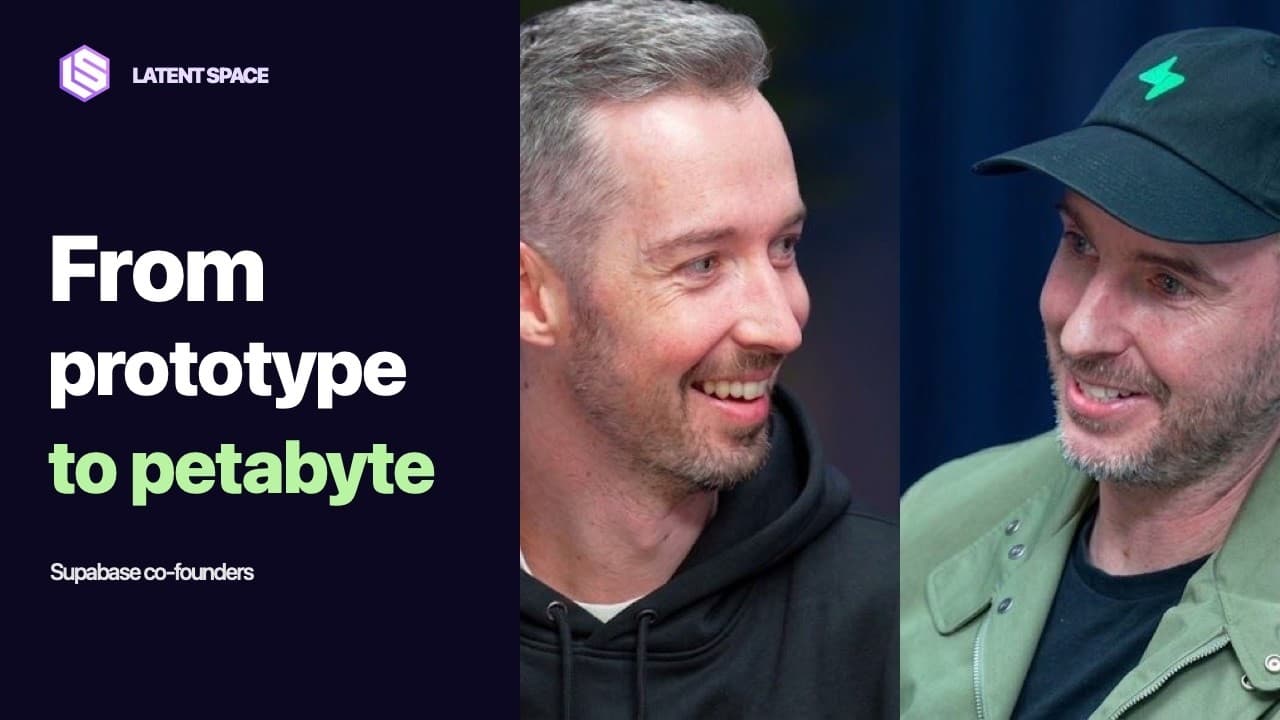
In a Latent Space podcast episode, Supabase founders Paul Copplestone and Ant Wilson discuss the company's Select announcements, grouped into Build, Operate, and Scale. Build features include a new alpha runtime for running Supabase locally without Docker, declarative database schemas kept in Git that an agent can read, change and fork, and Supabase Compute to run workloads beside the database. Operate adds logs, checks, connections and context to help an agent understand what it is changing. Scale covers OrioleDB, Multigres and the Turso acquisition behind a 'prototype to petabyte' positioning, as Supabase launches about five million databases a month. The founders say AI-driven agent usage improved activation and conversion because an agent can carry a user from signup to a working setup in one flow.