Heidelberg AI News
All stories
196 stories
Friday 30 October

ArticleThe Decoder
Open-weight model GLM 5.3 built full Firefox exploit chains with zero human input in under 48 hours
Researchers at Epoch AI report that the open-weight Chinese model GLM 5.3 autonomously built full Firefox exploit chains with no human input, exploiting the 'patch gap' between when security fixes appear in code and when they reach users. The model identified disguised security fixes, chained vulnerabilities with a previously unpublished flaw to bypass browser sandbox protections, and could read local files when a user visited a webpage. Attacks cost about $1,000 in API fees per Firefox version across six versions released Sept 17–Oct 26, taking 12 hours for the fastest and up to 48 hours. No API providers tested triggered safety guardrails. Mozilla patched the flaw in Firefox 159.0 (Oct 27). The same setup spent roughly $100,000 on Google Chrome without producing an equivalent exploit. Researchers warn the patch-gap risk spans the software industry and note untested benchmark data suggesting Kimi K3.1 Pro could outperform GLM 5.3 on offensive cyber tasks.
ArticleLatent Space
[AINews] Building AIE CODE: The top Coding Agent Conference
AINews covers three AI developments: Mistral Large 4 ('Le Chonk') shipped as an open-weights release built for agentic coding and cybersecurity, with 1.05T total and 52B active parameters, 1M context, text+image input, and pricing near $0.70/$2.10 per 1M input/output tokens; OpenAI now monitors all frontier RL runs, evaluations, and internal Codex use using activation probes, reviewer models over reasoning and tool use, and investigator agents; and Anthropic says Claude now produces a preliminary misuse assessment immediately after each response, which it says has surfaced misuse its classifiers were not designed to catch.
VideoNate Herk
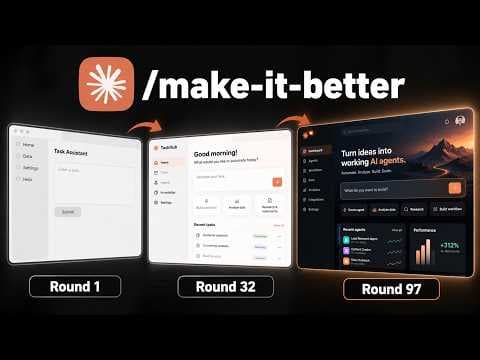
I Told Claude to "Make it better" 100 Times (It Went Too Far)
In a YouTube video, creator Nate Herk tested Claude Code by giving it a deliberately ugly coffee shop website and instructing it to 'make it better' 100 times in a row, running the experiment twice—once with Claude Sonnet 5.5 and once with Claude Opus 5.5, both at medium effort. Each run was in a clean room (new session, no skills, plugins, or memory), so each model relied only on its own knowledge and built-in tools. With Sonnet, the model made small, careful changes across 100 rounds, generating 11 images and 2 videos at a cost of about $29.93 in API billing, with code lines growing linearly while the actual quality gains were unclear. Milestones included the first AI-generated image and mobile-ready site (round 1), the first scroll animation (round 24), and the first online-ordering form (round 32). With Opus, the model kept adding features until the site reached 21,000 lines and started breaking itself. Neither model used web search even though it could. Herk's takeaway is that AI is not naturally good at thinking outside the box, and setting vague goals leads to getting stuck around the 80th improvement, so prompting must be specific and actively drive innovation to push past the 90-100 mark.
Thursday 29 October
- Simon Willison
ArticleSimon Willison
API credits benefit for eligible ChatGPT subscriptions
OpenAI has launched an API credits benefit for eligible ChatGPT subscriptions, mirroring a similar benefit Anthropic announced earlier for its Max and Team plans. OpenAI subscribers to its $100, $200, or $500 per month plans now receive the equivalent quantity of expiring credits to apply to one of their API organizations.

ArticleThe Decoder
OpenAI doubles usage limits on Pro plans as competition with Anthropic heats up
OpenAI is doubling usage limits across its paid plans, raising the Pro quota from 100 to 500. A planned cut to the Pro 200 quota was reversed after user pushback. More efficient models, described as Terra and Sol, are expected to push usable capacity even higher. The move comes just ahead of Anthropic's IPO, as both companies compete for B2B dominance in AI.
ArticleThe Decoder
Experts adopt AI agent's random opinions and think they're their own, Anthropic study finds
The Decoder reports on a study by Anthropic in which 50 experts were given an AI agent whose preferences were set randomly by coin toss. The experts followed the agent's opinions up to 86% of the time on judgment calls, and most believed the conclusions were their own.

VideoMatthew Berman
Two AI bots for spam calls and data privacy
Matthew Berman recommends two AI bots for privacy. One bot (referred to in the transcript as a 'Grokbot') automatically submits a phone number to do-not-call registries. The other, Privacy Scrubber, scans the web daily for personal information that may have leaked to data brokers and requests its removal.
- OpenAI
OfficialOpenAI
An updated Model Spec for more capable and beneficial AI
OpenAI published an updated Model Spec that outlines five core values intended to guide the development of more capable AI toward sound judgment, human agency, and faithfulness to human intent.
- Latent Space
ArticleLatent Space
Can Frontier Models See Past a Decoy? Elorian Tests Visual Reasoning
Elorian, which emerged from stealth in April with $55 million in seed funding co-led by Striker Venture Partners, Menlo Ventures and Altimeter Capital, launched its first visual reasoning model, Glimpse, described as a 'visual thinking model' that reasons about the physical world from what it sees. In partnership with AI data company Mercor, Elorian co-released DecoyCount, a benchmark testing whether models genuinely count objects or rely on visual shortcuts and substitution heuristics. According to a paper accompanying the release, frontier models scored below 50% accuracy, with GPT-6 Astra highest at 43.17%. CEO Andrew Dai said Glimpse scored 50.48% on 1,660 DecoyCount items in an internal test, making it the only model to clear 50%, though he noted the result came from a single run versus the frontier models' three-run averages. Dai, a former Google DeepMind researcher on GLaM MoE, PaLM 2 and Gemini, said the model uses visual thinking—generating and editing images as part of the reasoning trace—and distinguished Elorian's 'indirect action' approach from world models like World Labs' Atlas and Google's Genie 4.
- Simon Willison
ArticleSimon Willison
Quoting Ben Hylak
Ben Hylak is quoted saying that every product he uses should be a headless MCP that feeds into an agent, so he never has to think about anything underneath, except his own product, which keeps a UI that customers love.
OfficialDocker
Coding Agent Horror Stories: The CVE That Did Not Exist
An official Docker video describes a case in which an AI code review agent invented a CVE that did not exist and recommended dangerous fixes. It explains how Docker Sandboxes contain agents and why their output needs verification.
- Mistral AI
OfficialMistral AI
Le Chonk: Built for Coders, Trusted by Defenders.
Mistral AI has opened the weights of Mistral Large 4 (Le Chonk), a 1 trillion parameter multimodal model described as the best open-weight model for coding, trained in Europe.

ArticleThe Decoder
Google's AI search problem finally shows up in the earnings report, some investors believe
Google's stock dropped as much as ten percent after its quarterly earnings report. Cloud revenue more than doubled to $30.7 billion, but search revenue grew just 12 percent, slower than expected. Google acknowledged that its fast-growing AI mode brings in less revenue than traditional search, and it is now expanding its AI mode ad program internationally.
- OpenAI
OfficialOpenAI
How Ropes & Gray is developing AI for transactional diligence
Ropes & Gray is developing AI for transactional diligence in partnership with OpenAI. In this workflow, lawyers review grouped documents, summaries, and reports before advising their clients.
ArticleLatent Space
[AINews] Gemini 4 Carbon tops leaderboards, launches for cyber defenders
Google has launched its new frontier model, Gemini 4 Carbon, which leads independent evaluations and tops leaderboards. Access to the model is initially limited to trusted cyber defenders.

VideoMatthew Berman
Google "Carbon" just won everything...
Google announced Gemini 4 Carbon, its newest frontier model, claiming state-of-the-art cybersecurity and long-horizon capabilities. It ranks number one on Artificial Analysis's newly released index V5, scoring 59, above the previous best model, Claude Opus 5.5. The model is not yet publicly released; Google will first give it to cybersecurity partners and participate in a US government pre-release testing process before general availability. Google cites gains in coding, agentic tasks, and cybersecurity benchmarks (SEC bench pro, exploit gym, CWE patching). Introductory pricing is $2 per million input and $10 per million output tokens, rising to $4 and $20 after the introductory period, with 95% off cached input tokens. The model follows Gemini 4 Argon, launched two weeks earlier.
Wednesday 28 October
ArticleLatent Space
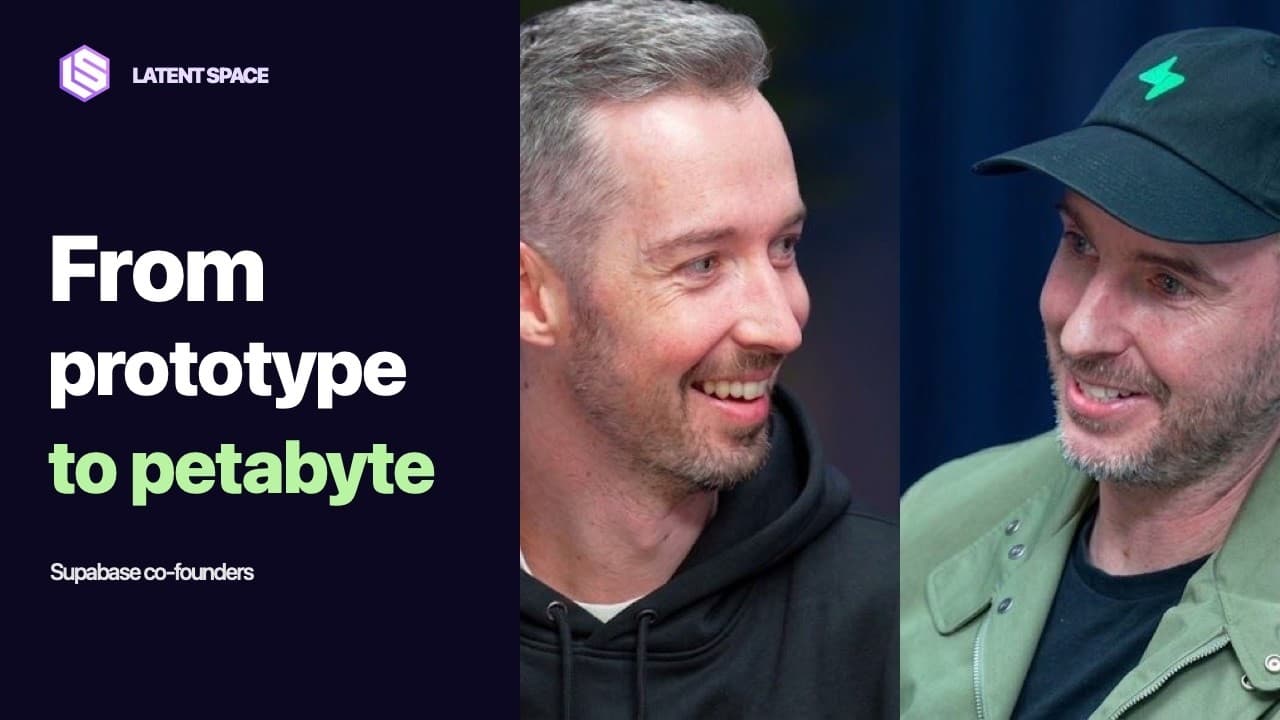
Why Agents Love Supabase
In a Latent Space podcast episode, Supabase founders Paul Copplestone and Ant Wilson discuss the company's Select announcements, grouped into Build, Operate, and Scale. Build features include a new alpha runtime for running Supabase locally without Docker, declarative database schemas kept in Git that an agent can read, change and fork, and Supabase Compute to run workloads beside the database. Operate adds logs, checks, connections and context to help an agent understand what it is changing. Scale covers OrioleDB, Multigres and the Turso acquisition behind a 'prototype to petabyte' positioning, as Supabase launches about five million databases a month. The founders say AI-driven agent usage improved activation and conversion because an agent can carry a user from signup to a working setup in one flow.

VideoMatt Wolfe
His AI Made 20 Reels Before Breakfast
In a 'show me your workflow' episode, Matt Wolfe interviews builder Nate Herk about three AI workflows he uses daily. First, an automated short-form video editing workflow built with Claude Code that Herk says can produce around 20 reels in a single morning, handling ideation, scripting, B-roll selection, and AI-generated video. Second, an AI expert panel called The Roast Room used to make better decisions. Third, an AI social media manager that researches, creates, and publishes Instagram content. Herk explains his approach to building 'skills' by reverse-engineering proven work and using a 'golden dataset' (like model evals) to guide output, noting AI still lags behind humans in music and sound design.
ArticleThe Decoder
Google Deepmind releases Gemini 4 Carbon just two weeks after Argon with gains across the board
Two weeks after releasing Gemini 4 Argon, Google DeepMind has launched Gemini 4 Carbon, a new AI model that tops the Artificial Analysis Intelligence Index v5 with 59 points. Google says the model is built for extended agent workflows and the full cyber defense lifecycle. Because of its advanced security capabilities, initial access is limited to selected security experts.

VideoTwo Minute Papers
Deepseek's New AI Has A Secret
Two Minute Papers reports that DeepSeek has released a new AI system, DeepSeek v4.1 Flash 1017, roughly five weeks after its prior version. In the creator's independent tests, it builds better working software and is much better at using the terminal to operate a computer. It is available through the API for a bit more than a dollar per million output tokens, which the video calls about 15 times cheaper than Claude Opus 5.5, though the creator cautions that cost per task is somewhat higher because DeepSeek can take two to three times more tokens than Claude Opus for the same task. The model's weights can be downloaded and owned for free, but running it requires H100-class hardware the creator cannot run at home. Because the architecture did not change, the creator hypothesizes the capability jump comes from 'learning from self feedback,' in which the AI critiques and improves its own work.

ArticleThe Decoder
Google opens Android development to third-party AI agents and unveils new Gemini APIs
Google is opening Android Studio to third-party AI agents through a new "Bring Your Own Agent" feature that supports more than 40 coding agents, including Anthropic's Claude Agent and OpenAI's Codex. Google says new terminal tools help agents complete UI tasks 77% faster while using up to three times fewer tokens, and Android development is becoming agent-centric. Google also unveiled new Gemini APIs.
- Simon Willison
ArticleSimon Willison
GitHub Octoverse 2026
GitHub's Octoverse 2026 report, announced at GitHub Universe by EVP Jay Parikh, shows developers now merge 220M pull requests per month, make 7.38B commits per month, and create 30.3M new repositories per month, with growth attributed to developers building with AI agents.
OfficialGitHub
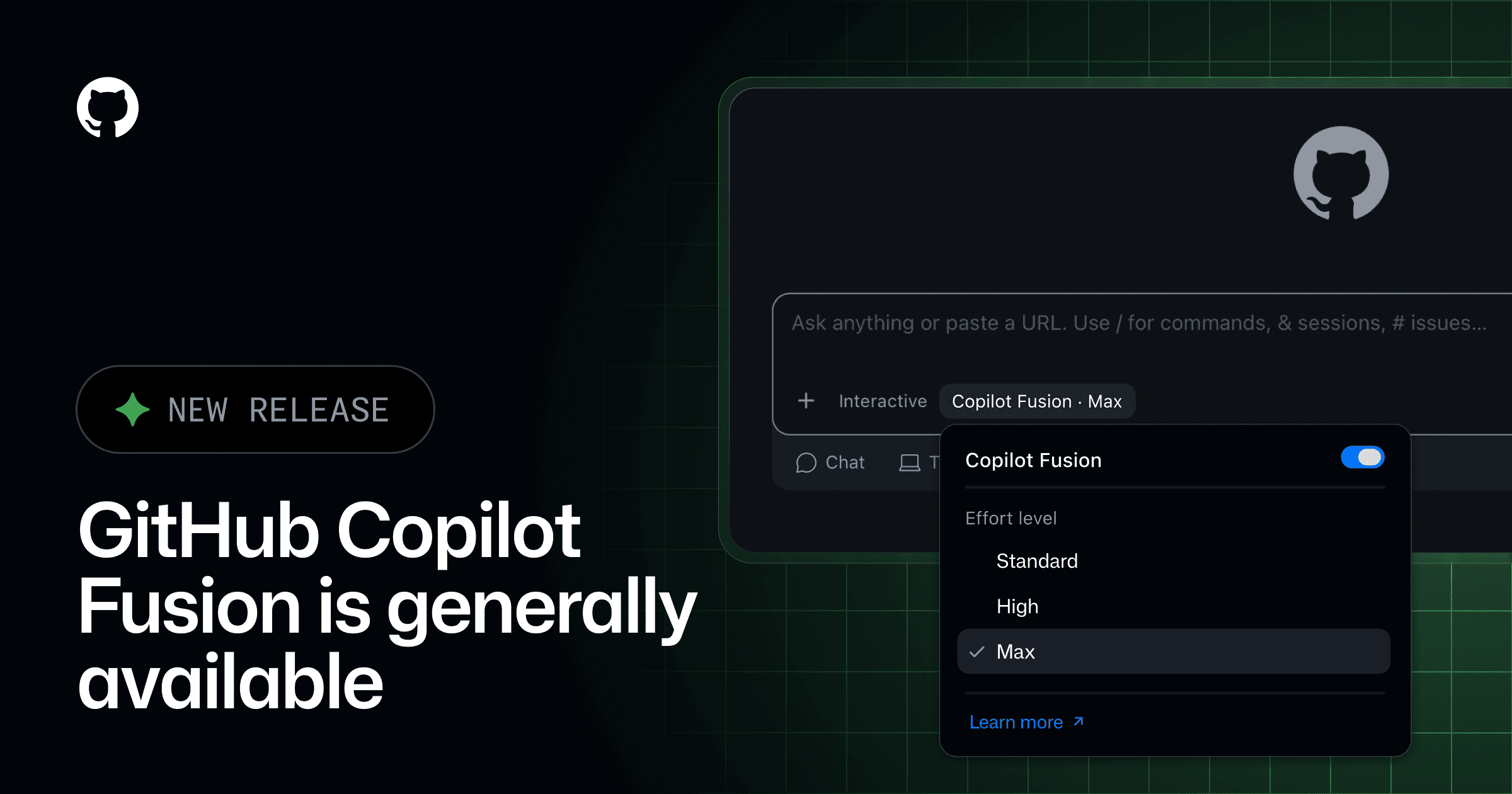
Route and orchestrate models with GitHub Copilot Fusion
GitHub Copilot Fusion is now generally available. Instead of selecting a model for each individual task, users can choose Copilot Fusion, which intelligently routes and orchestrates which models it uses for them.
OfficialGitHub
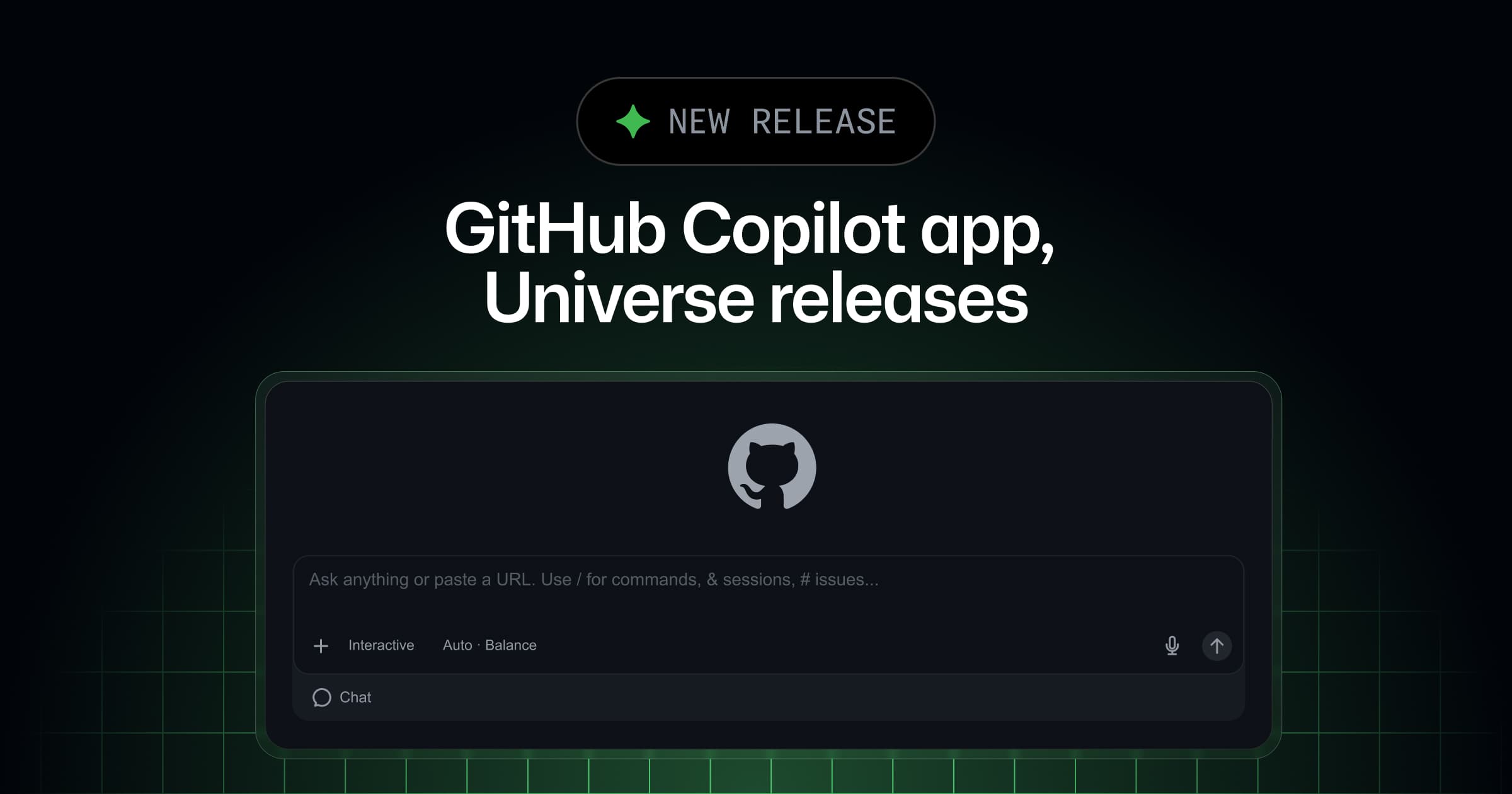
GitHub Copilot app, Universe releases
GitHub released the GitHub Copilot app and Universe features that let work extend beyond a single repository or session. A feature can span several repositories, and a launch plan can pull in specs, designs, and assets without touching a repository.
OfficialGitHub
GitHub Enterprise now includes access to GitHub Copilot
GitHub now includes GitHub Copilot access with GitHub Enterprise. Enterprises working with a GitHub or Microsoft account team can get Copilot included for every licensed user, instead of previously managing Copilot and GitHub Enterprise as two separate things.
OfficialGitHub
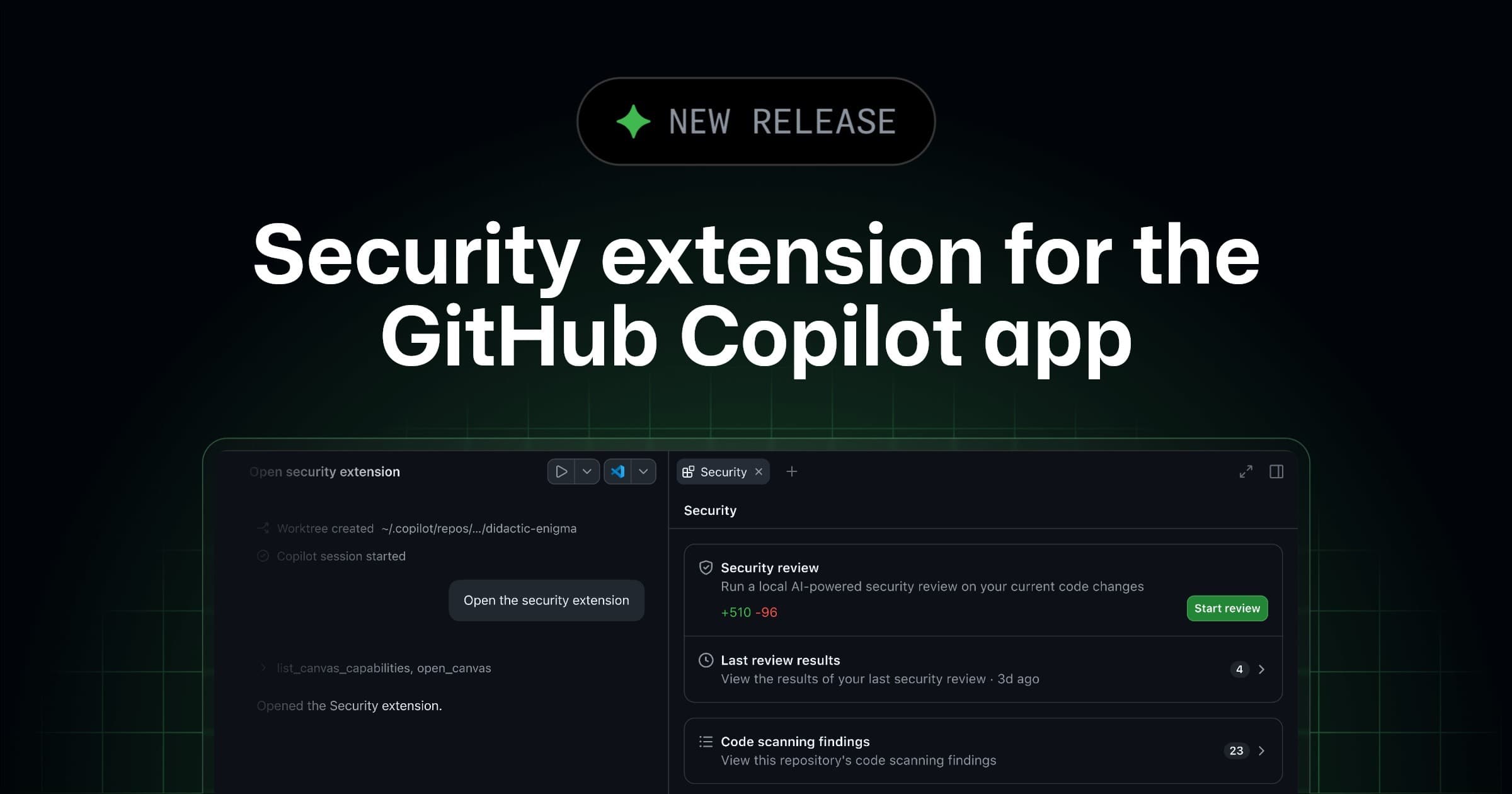
Security extension for the GitHub Copilot app
GitHub has introduced a new security extension for the GitHub Copilot app, now in public preview, which lets developers work through their repository's GitHub code scanning alerts without leaving the GitHub Copilot app.

OfficialGitHub
Build shared workflows for your team with Copilot Automations
GitHub is rolling out shared Copilot Automations, a feature that lets teams build and maintain AI-powered workflows together. With Copilot Automations, users can combine prompts, triggers, and tools to design workflows around their work.
OfficialGitHub
GitHub Copilot in VS Code, Universe releases
GitHub's official blog announced 'GitHub Copilot in VS Code, Universe releases,' describing a year-long focus on giving users more choice in how they work with GitHub Copilot in Visual Studio Code, including which models they use and where their agents run.
OfficialGitHub
Repository plugin defaults and enterprise plugin controls generally available
Repository plugin defaults and enterprise-managed plugin controls are now generally available in VS Code, Copilot CLI, and the GitHub Copilot app. Trusted repositories can install and enable default plugins, and enterprises can manage plugin controls across these tools.
OfficialGitHub
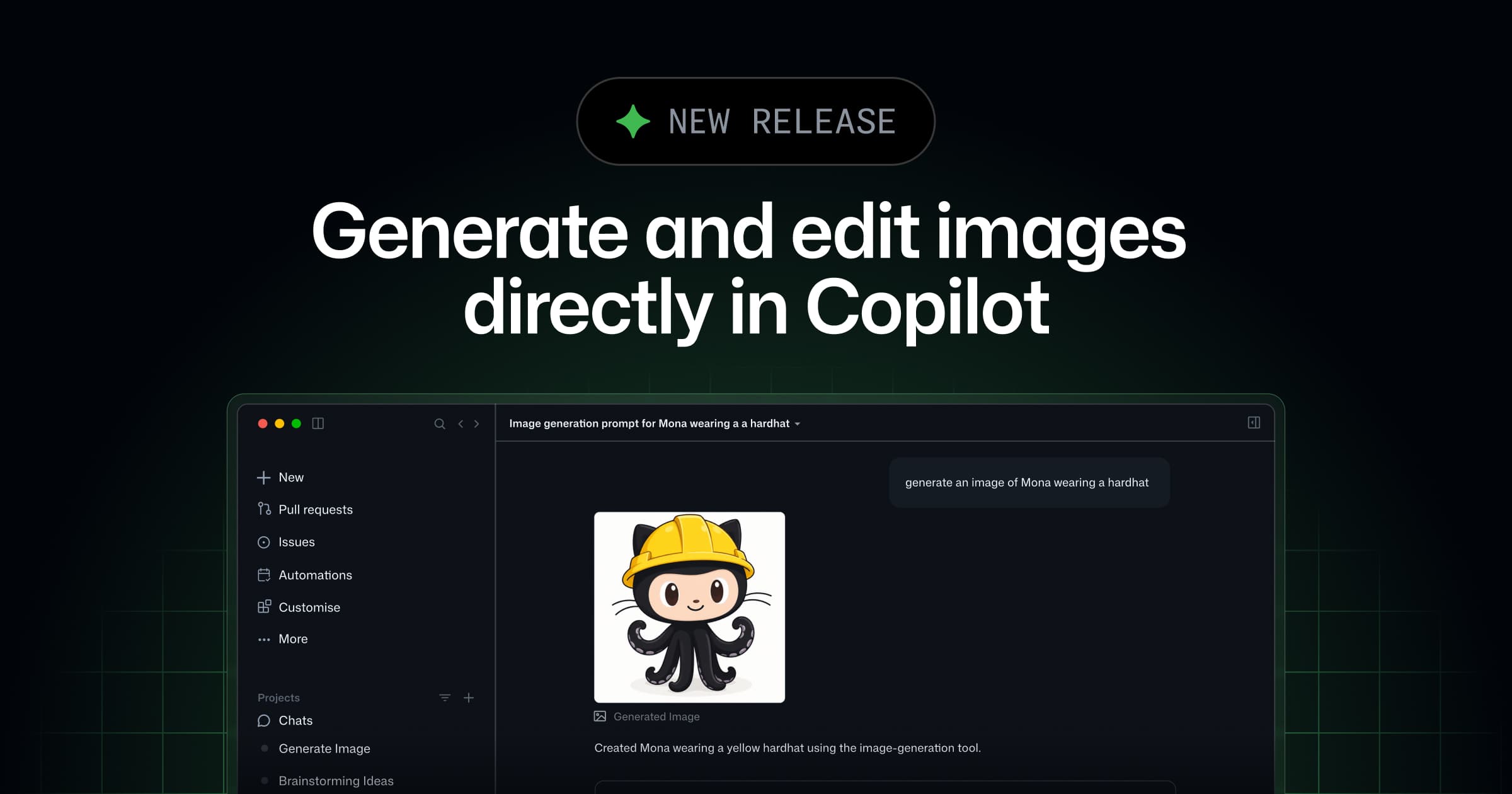
Generate and edit images directly in Copilot
GitHub announced that users can now generate and edit images using natural language in GitHub Copilot. When a user requests an image, their selected reasoning model calls a dedicated image-generation tool.