Heidelberg AI News
All stories
8 stories about Claude Opus 5.5
Saturday 31 October
- MarkTechPost
ArticleMarkTechPost
Meet Factory Droid 1.0: A Model-Independent Coding Agent Harness Built on Script Mode
Factory released Droid 1.0, a model-independent coding agent harness that makes programmatic tool calling the default. On Factory’s own Terminal-Bench 4 runs, Droid scores 65.2% with Claude Opus 5.5 at $4.73 per passed task.
Friday 30 October
VideoNate Herk
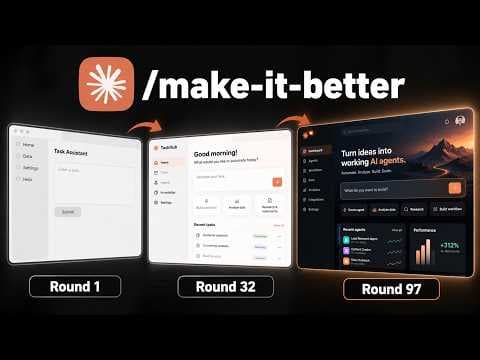
I Told Claude to "Make it better" 100 Times (It Went Too Far)
In a YouTube video, creator Nate Herk tested Claude Code by giving it a deliberately ugly coffee shop website and instructing it to 'make it better' 100 times in a row, running the experiment twice—once with Claude Sonnet 5.5 and once with Claude Opus 5.5, both at medium effort. Each run was in a clean room (new session, no skills, plugins, or memory), so each model relied only on its own knowledge and built-in tools. With Sonnet, the model made small, careful changes across 100 rounds, generating 11 images and 2 videos at a cost of about $29.93 in API billing, with code lines growing linearly while the actual quality gains were unclear. Milestones included the first AI-generated image and mobile-ready site (round 1), the first scroll animation (round 24), and the first online-ordering form (round 32). With Opus, the model kept adding features until the site reached 21,000 lines and started breaking itself. Neither model used web search even though it could. Herk's takeaway is that AI is not naturally good at thinking outside the box, and setting vague goals leads to getting stuck around the 80th improvement, so prompting must be specific and actively drive innovation to push past the 90-100 mark.
Wednesday 28 October

VideoTwo Minute Papers
Deepseek's New AI Has A Secret
Two Minute Papers reports that DeepSeek has released a new AI system, DeepSeek v4.1 Flash 1017, roughly five weeks after its prior version. In the creator's independent tests, it builds better working software and is much better at using the terminal to operate a computer. It is available through the API for a bit more than a dollar per million output tokens, which the video calls about 15 times cheaper than Claude Opus 5.5, though the creator cautions that cost per task is somewhat higher because DeepSeek can take two to three times more tokens than Claude Opus for the same task. The model's weights can be downloaded and owned for free, but running it requires H100-class hardware the creator cannot run at home. Because the architecture did not change, the creator hypothesizes the capability jump comes from 'learning from self feedback,' in which the AI critiques and improves its own work.
Tuesday 27 October
- Latent Space
ArticleLatent Space
How Anthropic ships Claude with Claude: Separating the Brain from the Hands
In a Latent Space episode, Anthropic's heads of engineering (Katelyn Lesse) and product (Angela Jiang) discuss the launch of Claude Opus 5.5, which has held the top-ranked LLM title for about a month, and the engineering behind the Claude Platform. The episode covers how Opus 5.5 is cheaper to run than its predecessor, changes to API integration including preserving thinking blocks across turns to protect reasoning against distillation, and how early access programs run evaluations in customers' own harnesses to see the model on tasks Anthropic's own products do not cover. A central mental model is separating an agent's 'brain' (session log and harness) from its 'hands' (the sandbox that executes code), which improves latency and reliability and adds security by keeping credentials out of the sandbox. The episode also covers Managed Agents' memory feature ('dreaming'), a roadmap that has shifted more attention toward safety, and the practice of evaluating agents.
ArticleLatent Space
How Anthropic ships the #1 LLM in the World safely: Separating the Brain from the Hands
In this Latent Space episode, Katelyn Lesse and Angela Jiang explain the engineering behind the Claude Platform, covering the launch of Opus 5.5, separating the model's 'brain' from the agent's 'hands,' scaling APIs, and building reliable managed agents.
Friday 16 October
VideoNate Herk
Matt Pocock: The Most Valuable Skill to Learn in the Age of AI
In a podcast interview, developer Matt Pocock—who taught himself to code and worked as a developer for roughly 18 years—explains how he now relies on AI coding agents. He says the best results come from telling agents what you care about and improving the codebase and environment they work in, because agents fill gaps with their own assumptions. He says spec-driven development made his code worse for months. He considers the release of Claude Opus 4.5 and Open Claw in December 2025 the point where he stopped writing code himself, and he runs Claude Opus 5.5 on medium effort. He argues software-engineering fundamentals—good tests, audits, and preventing error classes—matter more now, and that non-technical people can seize opportunities by using agents to identify cognitive workflows and present them to organizations. On trust, he recommends skepticism and reading primary sources rather than trusting agent output, noting that agent hallucinations have decreased but still occur.
Monday 28 September

VideoAlex Sprogis
Opus 5.5: Web Design Is FINALLY Fun Again (No More AI Slop!)
The video explains how to build websites that no longer look like AI-generated 'slop' using Claude Opus 5.5 (released by Anthropic and described as leading benchmarks). The presenter follows a structured four-step workflow across five example projects: a SaaS landing page, two e-commerce sites, an agency website, and a creative hobby project. Step one is collecting inspiration from web-design platforms such as Dribbble, Pinterest, Awwwards (nominated top-quality sites) and the paid Mobbin (which offers an MCP server with 6000 interface/website examples). Step two is generating a full design system via claude.ai/design, feeding in project descriptions, existing code, Figma references or uploaded assets. The presenter also mentions using license-free asset libraries like Lottie. The final step uses JavaScript libraries GSAP and Three.js to add 3D objects, cameras, lighting/shadow simulation, scroll animations and product configurators, turning sites into 'digital experiences'. Cookiebot is mentioned as a cookie-consent tool.
Sunday 27 September

VideoEverlast AI
Claude Opus 5.5 Is Incredible! Everything You Need to Know | AI News
This is a weekly AI-news roundup by Leonard Schmedding, filmed in San Francisco, covering recent developments for practical use. The main item is Claude Opus 5.5, the first model of Anthropic's new Claude 5.5 family (with Sonnet and Haiku 5.5 expected soon). It reportedly performs at the level of Claude Fable 5.1 while costing about 40% less than Opus 5, outperforming it on coding benchmarks such as Terminal Bench 4.0 and Cursor Bench and on knowledge-work tasks like GPQA and SWE-bench 2.0, though OpenAI's GPT-6 Astra retains an edge in automated business workflows and agentic research. Within hours OpenAI responded with GPT-6 Sol and Luna; GPT-6 Sol leads Anvil Labs' Vending Bench for autonomously running a vending-machine business. The video features a live report on 'Anthropic Market,' a boutique in San Francisco run entirely by Claude Opus 5.5, which manages products, prices, hiring via Slack, and social-media accounts (Twitter/Instagram), with books such as Ray Kurzweil's 'The Singularity Is Near' for sale. Other items: Claude detecting a molecular machine that Lord Dario Amodei sees as a potential new gene-editing mechanism and comparing biology's current leap to mathematics'; agent-based 3D/video generation using FreeGS and Blender; and Meta's Mus Charm keychain agent plus VR glasses competing with Apple Vision Pro. The creator also promotes his second channel, an Agentic Marketing workshop, Kiberatung AI-integration services, and a KI-continuing-education platform.